When a student opens a browser to begin research, where do they go first? A few years ago, the answer was fairly predictable. Today, for a growing number of students—and even experienced researchers—the answer is an AI environment. Research is increasingly beginning outside the library, outside the database, and outside the structured environment that librarians have long shaped.
This shift raises a question more interesting than whether AI helps people find information faster: What happens to the skills that doing research is supposed to build?
Over the past two years, this question has guided a series of AI experiments at JSTOR. Working alongside researchers, faculty, students, and librarians, we’ve been exploring how AI is changing research behaviors, and how we can design experiences that support learning rather than shortcut it.
Research is a set of behaviors, not just a search
Librarians have long understood that research is about more than finding information. It’s about developing judgment—learning how to ask good questions, navigate ambiguity, evaluate sources, make connections, and articulate original ideas.
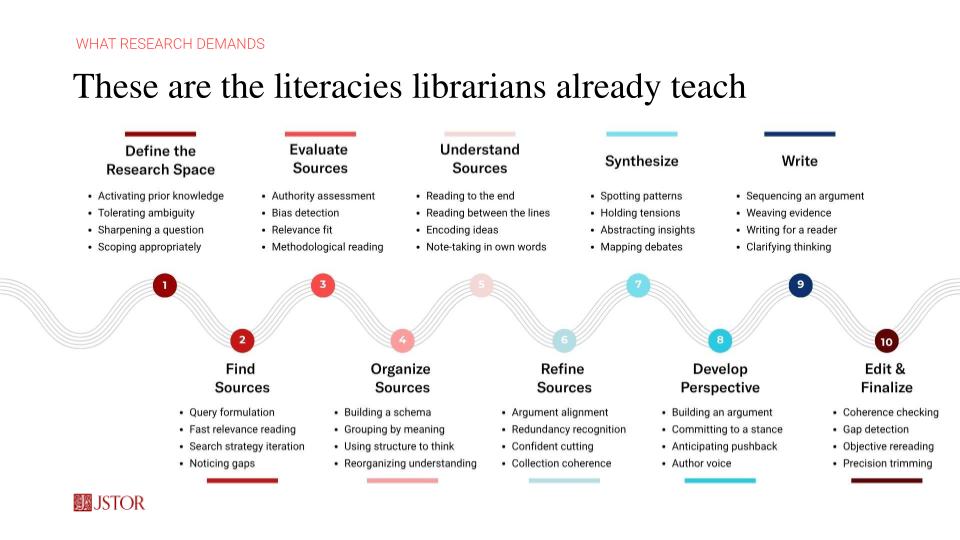
When you lay all of those activities out together, it becomes obvious how much is wrapped up in what we casually call “research skills.” Many students probably don’t realize they’re practicing all of these behaviors as they work through a research project. But that’s exactly how those skills develop: through repeated engagement with each part of the process.
As AI becomes part of research workflows, those distinctions can begin to blur. A single prompt can help formulate a question, surface relevant sources, summarize ideas, and suggest interpretations all within a single interaction. That doesn’t necessarily make AI good or bad. But it does change which research behaviors are visible, which ones are being practiced, and where researchers may need additional support.
As we began thinking about these changes, we found the ACRL Framework for Information Literacy to be a helpful lens. The framework shifts attention away from the mechanics of any particular search process and back to the underlying habits of mind that research develops. Even as AI changes how people interact with information, the core questions remain remarkably consistent: How do we frame meaningful questions? Evaluate authority? Build understanding from evidence? Contribute our own thinking?
Keeping those research behaviors at the center became an important principle for our work. Our goal wasn’t to judge AI, it was to better understand what was changing, and to explore how AI could support the development of research skills rather than bypass them.
What AI is actually changing
There’s a version of the AI-in-research conversation that focuses almost entirely on efficiency. Students may save time. Researchers may surface sources faster. Summaries can reduce the friction of engaging with dense texts. That framing isn’t wrong, but it doesn’t fully capture what we’re seeing.
AI doesn’t just accelerate research; it can change how people move through the research process.
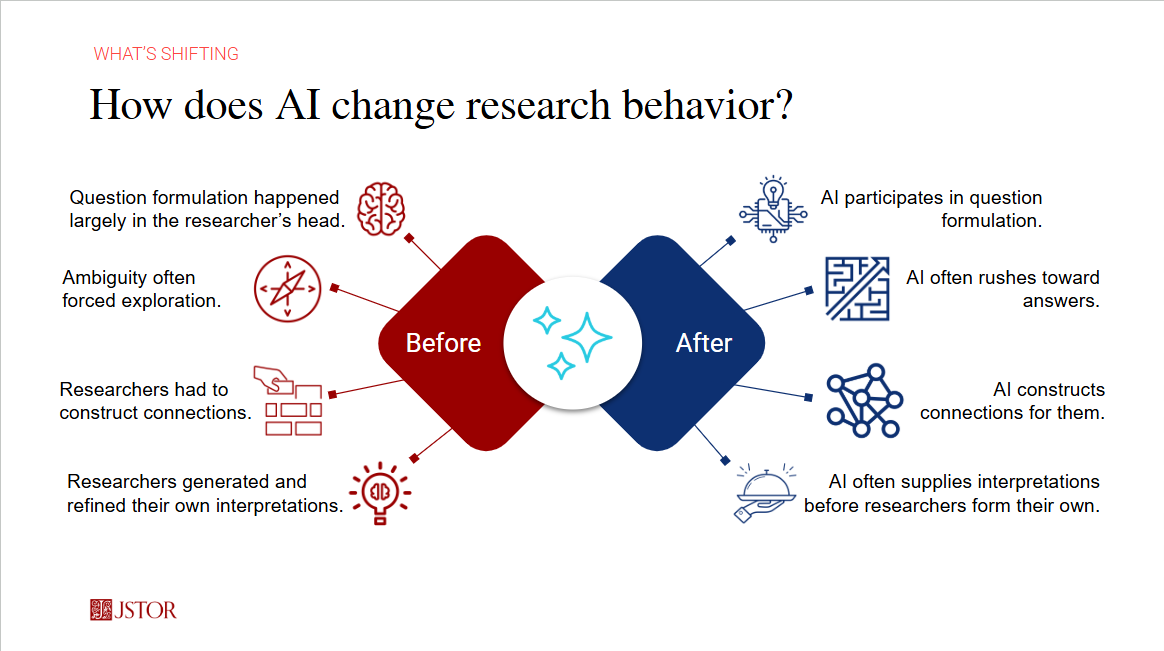
In more traditional research workflows, question formulation happened largely in a researcher’s head. Ambiguity could be uncomfortable, but it often forced exploration. Researchers spent valuable time constructing conceptual connections themselves. They generated and refined their own interpretations before arriving at conclusions.
Now AI can participate in question formulation. It can rush toward answers, often before the researcher has fully inhabited the problem. It can construct connections on the researcher’s behalf. It can supply interpretations before the researcher has had a chance to form their own.
That doesn’t make AI catastrophic. But it does change what’s being practiced. And in educational settings, what’s being practiced is what’s being learned.
One librarian we spoke with put it simply, “It gets you up on this rung of the ladder. Now you’ve got to climb to the next one.” That metaphor stuck with us. Good AI should help researchers climb. It shouldn’t carry them.
The challenge we set out to solve
When JSTOR began exploring generative AI in 2023, we weren’t chasing a trend. We were trying to solve something specific: How do you design an AI experience that supports the development of research skills rather than bypassing it?
Before we built anything, we established principles. We wanted to honor JSTOR’s mission of expanding access to a credible, scholarly research experience. We wanted to help people think, not think for them. We wanted to make tools intuitive without replacing human judgment.
Those principles shaped every design decision that followed. Every AI experience we built would need to stay connected to the source material, maintain transparency and traceability, and keep human judgment central. We deliberately chose productive friction over maximum convenience, preserving the moments where researchers need to ask another question, verify a claim, or make a connection themselves.
That might sound like a small thing, but it’s a different optimization than many AI tools pursue today. Ours needed to be optimized for something harder to measure: learning.
What user research taught us
We began with a focused experiment: a single-document AI experience on JSTOR. We weren’t trying to prove that AI belonged in research. We were trying to understand what a trustworthy AI experience for research should look like. Rather than building AI into search or generating broad research summaries, we designed a tool that deepened engagement with individual texts. Every response was anchored to the full text, with citations linking directly to relevant passages. The tool encouraged users to probe arguments, trace concepts, and develop better research questions rather than receiving interpretations ready-made.
What we learned shaped everything we built next.
Researchers consistently want AI to be a thinking partner, not a replacement for their own thinking. One faculty participant, Cathy, described it as a “we’re in this together” relationship. She isn’t looking to replace her own thinking. She is looking for something to think alongside.
At the same time, researchers still want to verify what AI produced. Dave, a librarian, named the dynamic precisely, “It’s a trust but verify relationship.” He noted that the tool doesn’t spare you the verification, because your name goes on the work. That accountability remained real, even with AI assistance.
The tradeoffs are real too. Our single-document approach was consistently described as trustworthy and grounded, but also limiting. Researchers wanted to move beyond one article, to follow threads across sources, to explore the broader landscape of a topic. We had preserved close engagement, but constrained broader exploration. That tension shaped the direction of our next set of experiments.
The novice-to-expert model isn’t enough anymore
One thing our research challenged was how we think about the people we’re designing for.
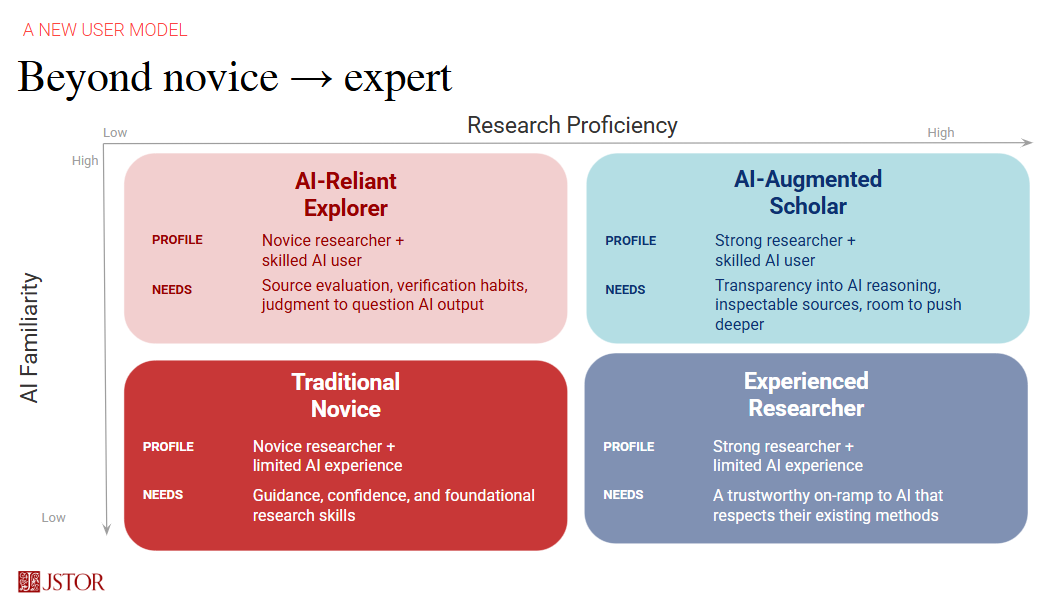
For a long time, research support operated along a familiar axis: novice to expert. Library instruction, database design, research guides—all of it was calibrated to move people from beginner to proficient. But AI introduces a second dimension that the novice-to-expert model doesn’t account for: AI familiarity.
We’ve come to think of research expertise and AI familiarity as two separate dimensions. A student can be new to scholarly research and highly skilled with AI tools at the same time. An experienced faculty member can be deeply accomplished as a researcher and barely have touched a generative AI tool. These aren’t the same kind of user, and they don’t need the same kind of support.
The quadrant that concerns us most is the one we’ve started calling the “AI-reliant explorer,” a novice researcher who is also a skilled AI user. This person can produce polished, confident-sounding output without having developed the underlying research judgment. It’s the appearance of expertise without the substance. They need, above all, support in source evaluation, verification habits, and the capacity to question what AI produces.
At the opposite corner, a faculty member we spoke with named Nicholas described the expert-with-AI dynamic as being like a master carpenter expertly using a tool, “I’m going to use this—it helps us to accelerate things, but the scholar has to confirm, and ultimately know.” He uses AI to move faster, but the judgment, the confirmation, and the ownership of the result remain entirely his. The tools he needs are different: transparency into AI reasoning, inspectable sources, room to push deeper.
Thinking about researchers this way has helped us ask better design questions.
Putting principles into practice: Dynamic Search and JSTOR GPT
Our user research also gave us a clearer picture of what researchers were looking for: partnership, accountability, and support for learning. Those insights led to our newest experiment, “Dynamic Search,” which is designed to support more of the research process without taking it over.
Dynamic Search emerged from the questions we’d been asking about research behaviors, not simply from what AI is capable of. The goal is to help researchers refine their questions, encourage exploration, create space for ambiguity, and guide next steps without performing those steps on their behalf.
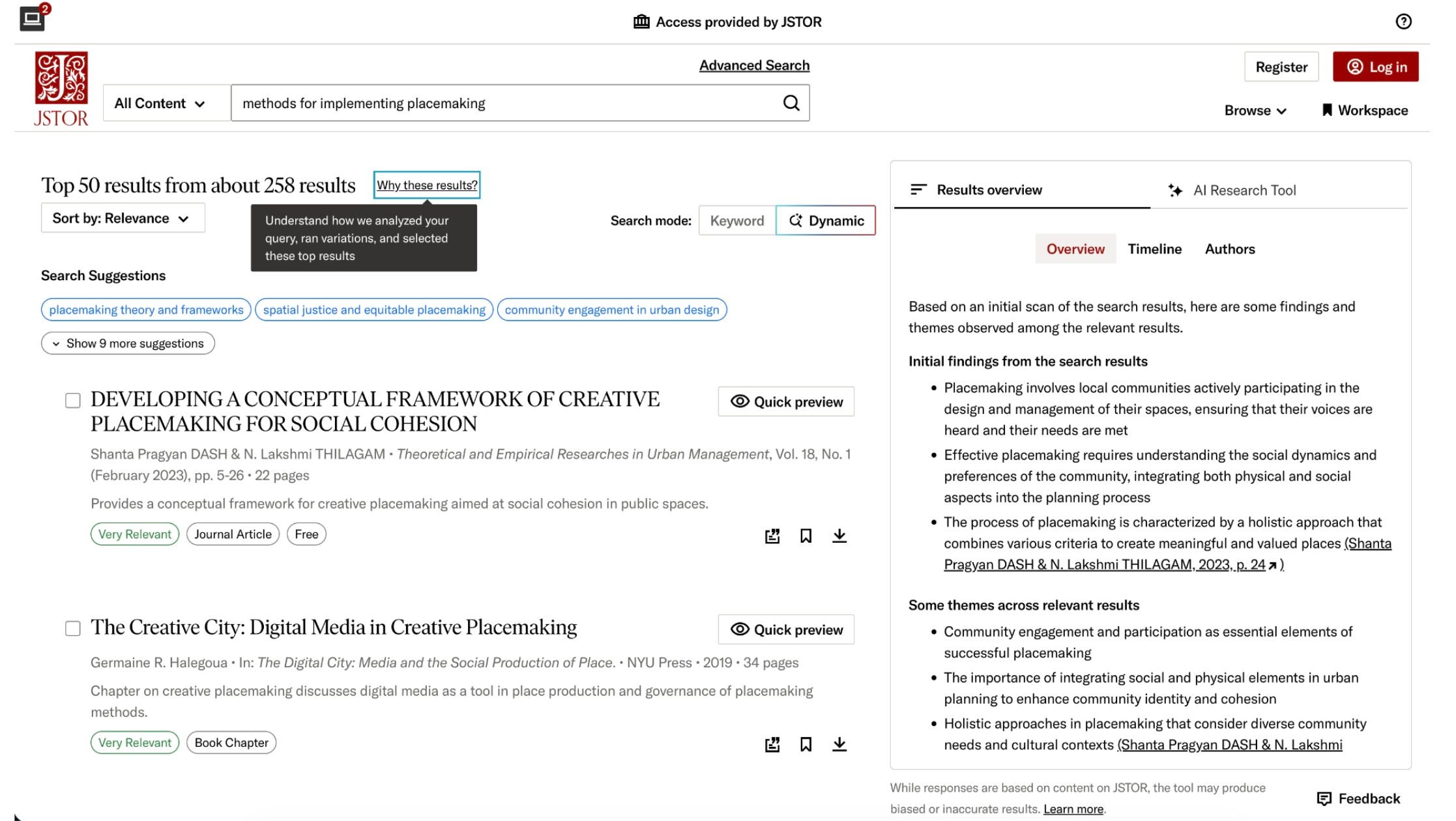
What we heard from early testers tells us we were on the right track. One undergraduate student, Tracy, noted that the tool “gives you a couple of thought starters, but it doesn’t outline the whole process for you like some other AI would do.” A graduate student, Ash, described how it prompts you to zoom in and zoom out on a question, and observed that it doesn’t do the narrowing for you, it helps you do it yourself. Another graduate student, Jason, put it plainly: he felt the tool was “helping to narrow down the sources” without doing his thinking for him.
That’s the distinction we’ve been working toward. Not whether AI is present in the research process, but whether it preserves the researcher’s agency within it.
We’ve also been experimenting with a JSTOR GPT, currently in beta, a conversational AI experience designed to support the earliest stages of research by defining the research space, brainstorming and refining questions, discovering relevant sources, and thinking through next steps. Here too, we deliberately designed against the tendency of conversational AI to provide answers too quickly. A conversational AI wants to give answers. We need ours to ask questions back.
One graduate student, Arul, described the experience this way, “It’s less sycophantic than my usual GPT—this one is asking questions back to me, asking me to specify things, which makes me think even more.” That’s encouraging, but we’re still learning. Users have been direct about where the guardrails need work: they want clearer transparency about how searches are generated and why sources are surfaced, and they want stronger protection against AI quietly reframing their arguments. Those boundaries are real, and we haven’t fully solved them yet. The beta process continues to shape how the experience evolves.
What remains open
We’re still in the middle of this. The questions we’re carrying forward are genuinely open, and we think they’re the right ones for us to explore together.
How do different kinds of researchers develop research skills in AI-mediated environments? We’re beginning to understand the four quadrants of our user model, but our understanding is still evolving. As AI tools proliferate and users develop new habits, the landscape will keep shifting.
Where research begins is also a question for libraries and platforms alike. If students are starting with AI before they ever arrive at a database, how do we create pathways that encourage research behaviors from the moment of first contact—wherever that happens to be?
Libraries are also building their own trustworthy AI environments, and we’re thinking carefully about how JSTOR can support and extend that work through connectors and integrations that don’t duplicate effort but extend what libraries are already doing well.
And perhaps most importantly, as we continue to learn across each quadrant of our user model, how do we create greater value for all of them—not just the most sophisticated users, but the AI-reliant novices who may need our intervention the most?
An invitation to keep thinking together
Perhaps the most important thing we’ve learned is that designing AI for research isn’t just a product challenge. It’s a community challenge.
What shared language do we need to talk about research behaviors as they evolve—not just within institutions, but across platforms, libraries, and classrooms? Where do your users sit in the matrix of research expertise and AI familiarity, and how does that change the way you think about supporting them? What would make an AI tool one you’d trust enough to recommend to a student or a colleague?
These aren’t questions JSTOR can answer alone. The best answers will come from continuing to learn alongside libraries, faculty, researchers, and publishers as we explore what trustworthy AI-enabled research experiences should look like.
Learn more about JSTOR’s AI-enabled features