This article is a part of the Inside & Connected series, which shares ideas, interviews, and projects that affect prison-based education, students, and educators.
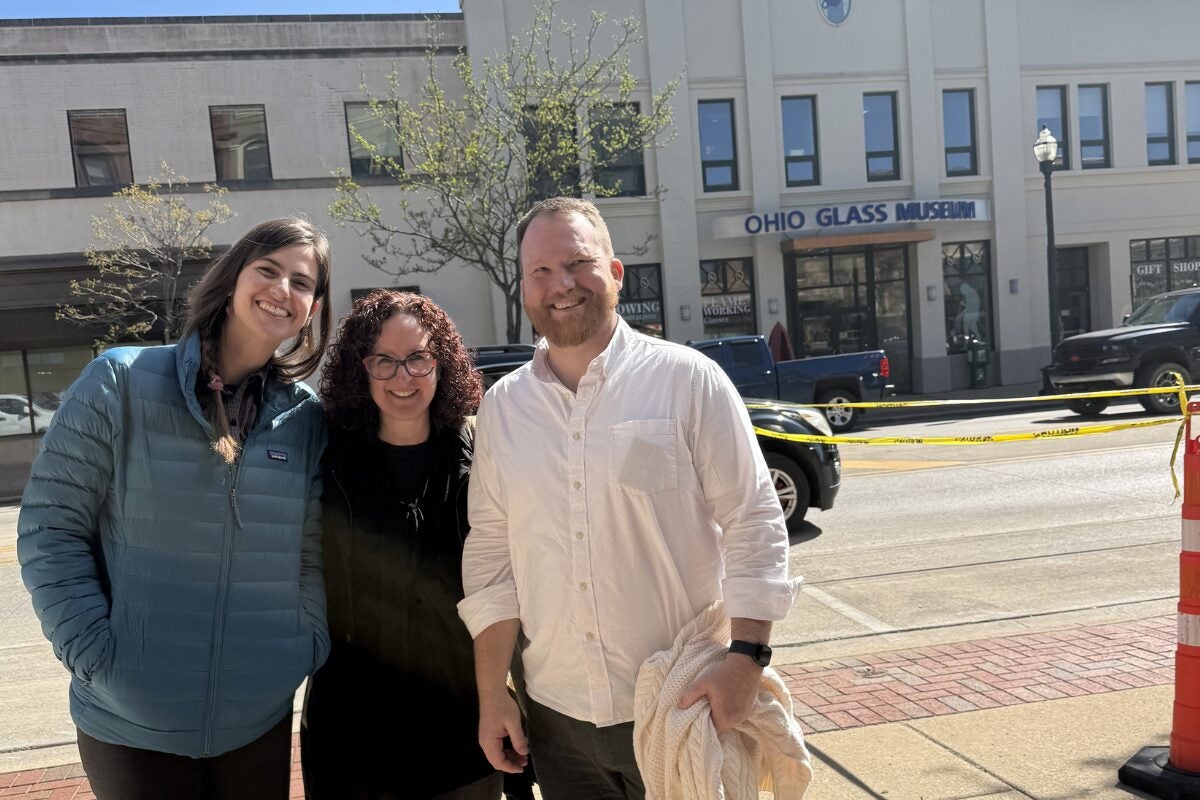
This April, ahead of the 15th National Conference on Higher Education in Prison, the JSTOR Access in Prison team was invited by the Philosophy for Humans (P4H) learning community at the Southeastern Correctional Institution (SCI) in Lancaster, Ohio, to visit their facilities and spend an evening brainstorming in community. This opportunity built on a previous visit to SCI just last year by our former colleague, Elizabeth Shatswell, a current Rockwood Fellow. Beyond community-building, it was a trip intended to help our team, with a range of lived experience and proximity to the carceral system, get a better understanding of how people on the inside are using JSTOR. While we spend a lot of time thinking about how people are learning on the inside and what tools they have to help them in their journeys, we only rarely have a chance to talk directly with the people who are actually learning in prison.
Our work at JSTOR Access in Prison and ITHAKA Labs is underscored by an intersectional appreciation of arts and humanities, so it was no surprise that Elizabeth Lovero (Sr. Software Engineer), Grace Cope (User Experience Designer), and I chose to start our day in Columbus with a visit to the Wexner Center for the Arts, where we watched Naeem Mohaiemen’s Through a Mirror, Darkly, a video art piece exploring violent responses to protests against the Vietnam War at Kent State in Ohio and Jackson State in Mississippi, as well as in New York. The legacies of violence, and especially of state violence, remained with us throughout the day.
To get to the prison, we were picked up by Dr. Amy Shuster, a co-convenor of Philosophy for Humans (P4H), member of the Ohio Prison Education Exchange Project (OPEEP) Advisory Council, and one of the lead coordinators behind this trip. Amy has been teaching at the Southeastern Correctional Institution for several years, so the car ride quickly became a briefing zone to help us digest the thoughtful materials. questions, and zines P4H shared ahead of time, and prepare for our visit to SCI.
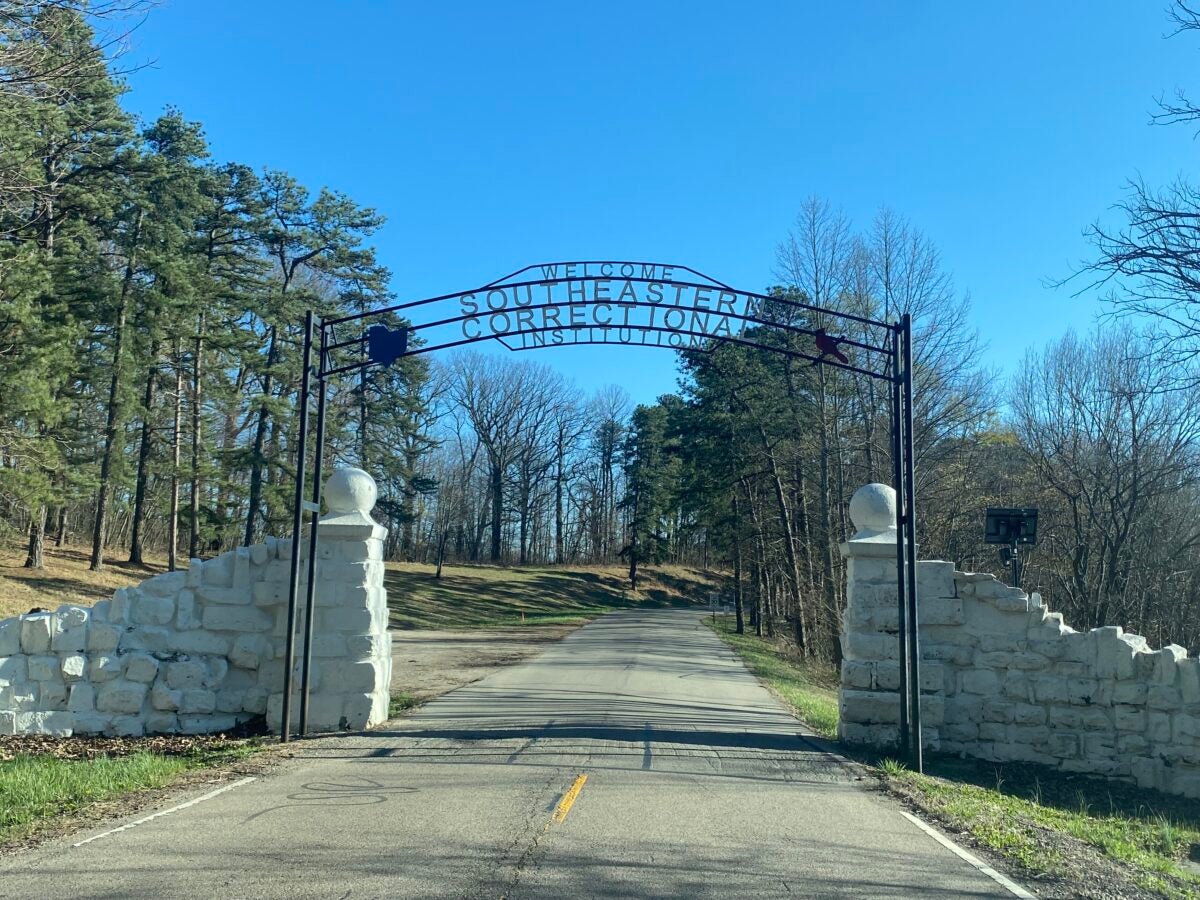
Visiting a prison comes with a number of restrictions, and these can vary from state to state. At SCI, we were not permitted to bring phones, smart watches, or even paper, but we could bring laptop computers. We could not wear necklaces, camouflage, or boots. We would pass through a metal detector and turn over our identification in exchange for visitor cards. Knowing all this in advance allowed us to go through the process with a little less stress.
Touring educational facilities inside
Once through security, we met with one of two librarians at the facility, who walked us through the physical learning spaces and types of educational resources that learners have access to at SCI, including JSTOR. At SCI, learners can choose from a handful of vocational courses, classes from Ohio State University or use Pell funding to take credit-bearing classes from Sinclair Community College. Together, we walked through three key spaces where learners have access to technology: a center for workforce readiness and training, a computer lab exclusively for students in higher education in prison programs, and a surprisingly well-provisioned library.
While in the computer lab, we met IS, a dedicated tutor who has been participating in higher education in prison programs for years, and has taken classes and done research in an astonishing number of fields. Walking us through JSTOR on the “tutor-only” desktop computer in the lab, it was clear that his knowledge of JSTOR and how to navigate it within constraints of prison technology contributes greatly to the success of other students undertaking their own academic research. He was particularly enthusiastic about his Disabled Ecologies course, an inside-outside class taught by Dr. Alia Dietsch through OPEEP, and even showed us some articles he had teed up to read, like one on the controversies of the Love Canal, a superfund site in New York.
Unfortunately, we learned how access to JSTOR is limited at SCI. The computers in the library are in high demand for law library and legal research work. There literally aren’t enough electrical outlets to run additional computers for non-legal research, which isn’t uncommon in the prison education space. Only students in higher education programs are able to regularly access JSTOR in a dedicated computer lab, and the facility doesn’t expect to have the technology budget to make any changes anytime soon.
A hands-on workshop
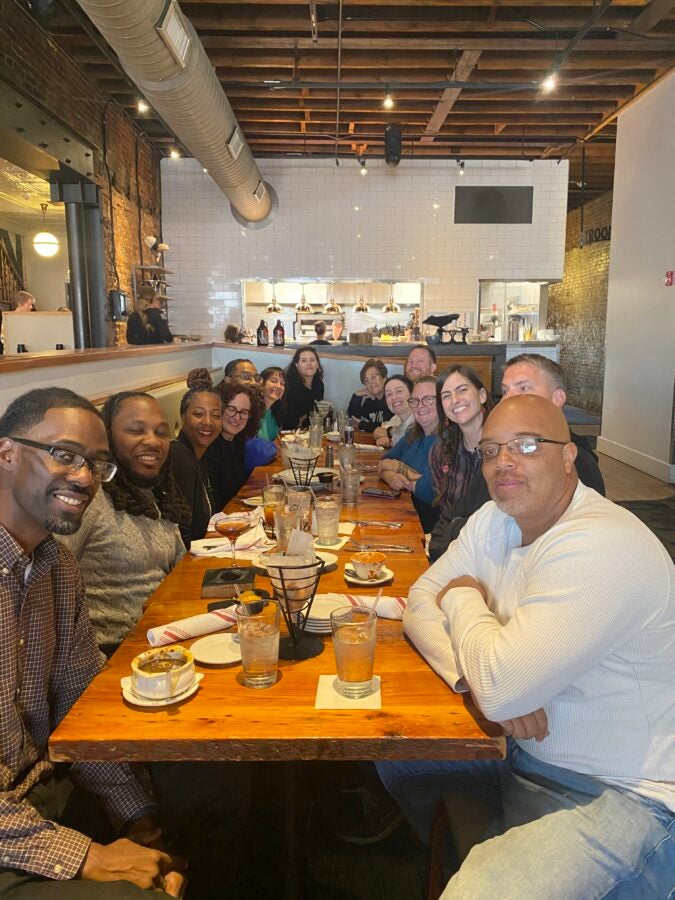
We met for an early dinner with Elizabeth Shatswell and a majority of the cohort of the Rockwood Fellowship for Leaders in Higher Education in Prison who we would be joining for the evening workshop with the Philosophy for Humans learning community. Once through security again, we settled into a big circle in the classroom where P4H convenes monthly between inside members, who live at SCI, and outside members, who live in and around Columbus. The classroom was a standard education room – high ceilings, white brick walls, two big white boards. That night, it held over 30 of us, blending a group of intergenerational, long-term culture workers, folks recently released, people with long sentences, and some never having stepped into a prison before. Every conversation was intentionally curated and facilitated by P4H, starting with a round of introductions from the prompt: “What are the most important things that brought you here tonight?”.
We broke up into smaller groups to discuss topics like prison abolition, reentry, and educational opportunity, asking things like: What kind of opportunities should exist for you that don’t currently? What would it take to make them real? What elements of your lived experience are either not asked about or seen, yet are important to our collective work? What venues for publishing our stories are you aware of? What supports and obstacles did you encounter during your process of re-entry? How do you think about prison abolition? Notes from P4H captured insights on big sticky note pads, not unlike what our work often looks like at ITHAKA Labs, and we ended the night with an unstructured debrief to round out getting to know each other and share ideas.
Takeaways & continuing the commitment
We walked away from time together with Rockwood and P4H with a recommitment to centering folks inside – from devising new ways to get direct feedback from people using JSTOR inside prisons to having more open conversations as a team about the identities and ethics we bring to this work as artists, abolitionists, and academics in our own time. We are so grateful to Elizabeth and Amy for helping us navigate the bureaucratic hurdles to visit the facility, and to the members of P4H for facilitating and hosting us. Our team is already planning more site visits with our educational partners across the country. P4H continues to grow and change and is already planning more engagements and is open to collaborations.