At ITHAKA and JSTOR, our work has always been closely tied to the academic community as both a service provider, and a participant in the broader ecosystem of research and scholarship.
As AI becomes more embedded in how people discover, interpret, and use information, that role is evolving. It requires building tools and actively engaging in the conversations shaping how those tools should work. Participating in the Ethics at the Front-End workshop at CHI 2026 was part of that ongoing commitment.
CHI, the ACM Conference on Human Factors in Computing Systems, is one of the largest and longest-running venues for research on how people interact with technology. It brings together researchers, designers, engineers, and industry practitioners from around the world.

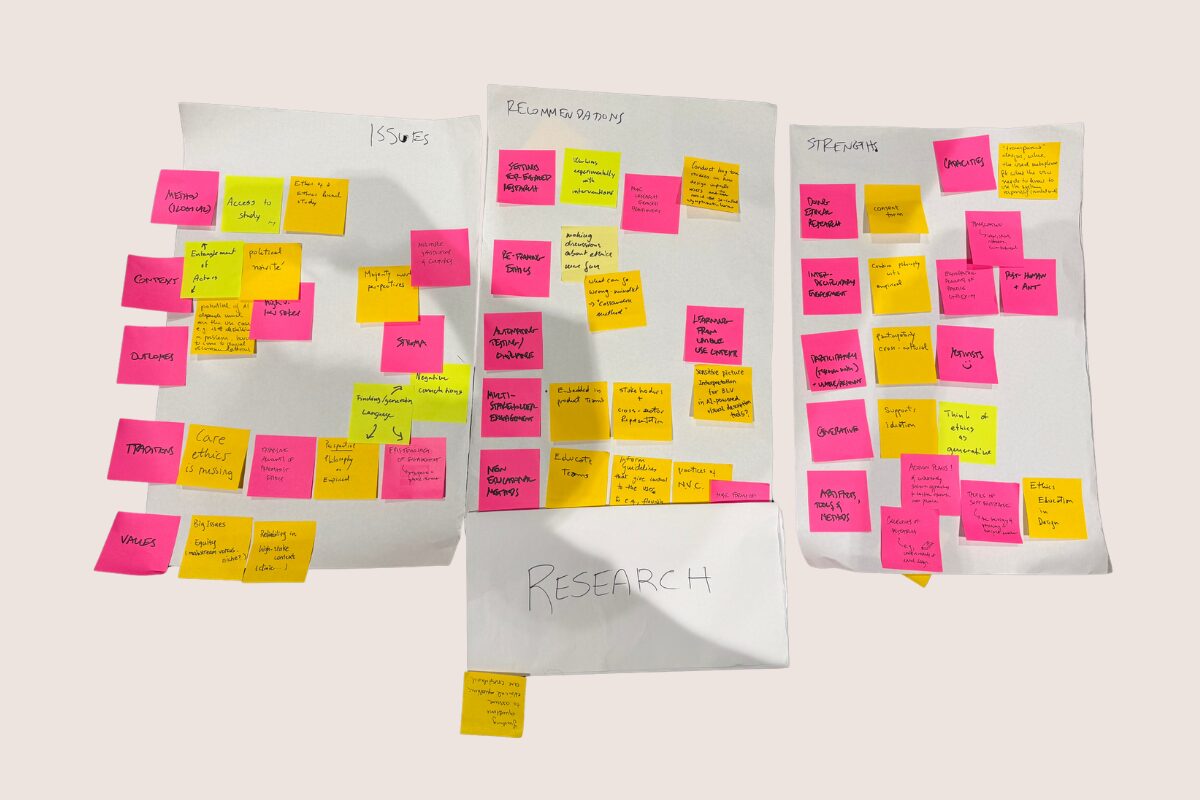
As someone working on JSTOR at the intersection of scholarship, product design, and user experience, I’m often thinking about how research translates into real-world systems. In this workshop, I saw those same considerations reflected back from multiple angles. We had participants working across academia, industry, and policy, exploring a shared question: what does it mean to design AI interfaces responsibly? Academic researchers brought theoretical frameworks and critiques, while practitioners brought constraints, tradeoffs, and lived implementation challenges.
Together, those perspectives created a more comprehensive understanding. It also reinforced something we’ve seen in our own work: that designing AI systems responsibly requires more than a single vantage point. It requires partnership across the academic community.
Shared considerations in AI interface design
Our own contribution to the workshop, a case study on scaffolding scholarly judgment through front-end design (co-authored with Diba Kaya, Senior User Researcher), explores ideas such as scoped agency, transparency, the role of friction, and legible agency. (Read the full paper here.)
Within the workshop, several themes emerged that were closely aligned with the research and design decisions behind JSTOR’s AI research tool. Here are a few of the key themes we discussed:
Supporting user agency
Participants emphasized that AI systems should not displace human judgment. Instead, they should support it.
This aligns with how we’ve approached the research tool: designing interactions that keep users in control of inquiry, rather than outsourcing it to the system. The goal is to support users as they think, rather than shortcut that process.
Transparency as a design responsibility
Transparency emerged as both a principle and a practical challenge. How do you make system behavior understandable without overwhelming users?
In our case, this has meant grounding AI responses in source material (linking outputs directly back to the text) so users can verify, interpret, and build their own understanding.
Across the workshop, similar approaches surfaced: making AI legible, inspectable, and accountable through interface design.
Designing for “exponential pathways”
One idea that resonated deeply was the notion of exponential pathways. In AI systems, we can’t anticipate or document every possible output or user path because the combinatorial space is simply too large. This has implications for how we design. Instead of relying on rigid decision trees or exhaustive specifications, we need to provide directional guidance—interfaces that help users navigate possibility spaces without trying to predefine them.
This mirrors a shift we’ve experienced in our own work: moving from controlling outcomes to shaping conditions for good judgment.
Friction as a feature, not a bug
Another recurring theme was the role of friction. In many product contexts, friction is something to eliminate. But in learning environments, friction can be essential. It slows users down, encourages reflection, and creates space for interpretation.
This idea is central to the research tool, where interaction is intentionally scoped and paced to support active engagement rather than passive consumption.
At the workshop, this reframing of friction as a pedagogical tool was widely shared.
The realities of scale
Participants also raised the practical challenges of scaling AI systems. Responsible design choices carry real costs, requiring infrastructure, iteration, and ongoing evaluation. There was a clear recognition that ethical design is not just a conceptual challenge, but an operational one.
Keeping focus on positive change
Amid these discussions, one theme stood out as both simple and easy to overlook: joy. Not in the sense of delight as a design flourish, but in terms of what the tool enables for a person. What does this system make possible? What kind of thinking, discovery, or progress does it support?
This focus helps ground ethical considerations in the lived experience, not just abstract principles.
Resisting the urge to humanize AI
Finally, there was strong alignment around a caution: to resist framing AI as a person. AI is not an expert, collaborator, or friend. AI is a tool.
Over-humanizing systems can obscure their limitations and shift authority in subtle ways. Designing with clarity about what AI is and isn’t, helps maintain appropriate expectations and responsibility.
A broader conversation
One of the most valuable aspects of participating in this workshop was seeing how closely our work at JSTOR aligns with, and contributes to, a broader conversation. Being able to place our case study alongside others, and see shared challenges emerge independently, was both grounding and motivating.
The design and research behind the AI research tool are part of an evolving dialogue about how AI systems should function in knowledge environments. For me, this workshop was a reminder that designing AI systems is also a form of participation in shaping the future of academic research.
At JSTOR, we’re contributing to how scholars, students, and educators will engage with knowledge in an AI-mediated world. That responsibility extends beyond functionality to include how we design interactions, structure choices, and signal meaning. And it benefits from being in conversation with researchers, practitioners, and communities grappling with the same questions.
Ultimately, the challenge isn’t just building AI that works. It’s building AI that supports how people think.