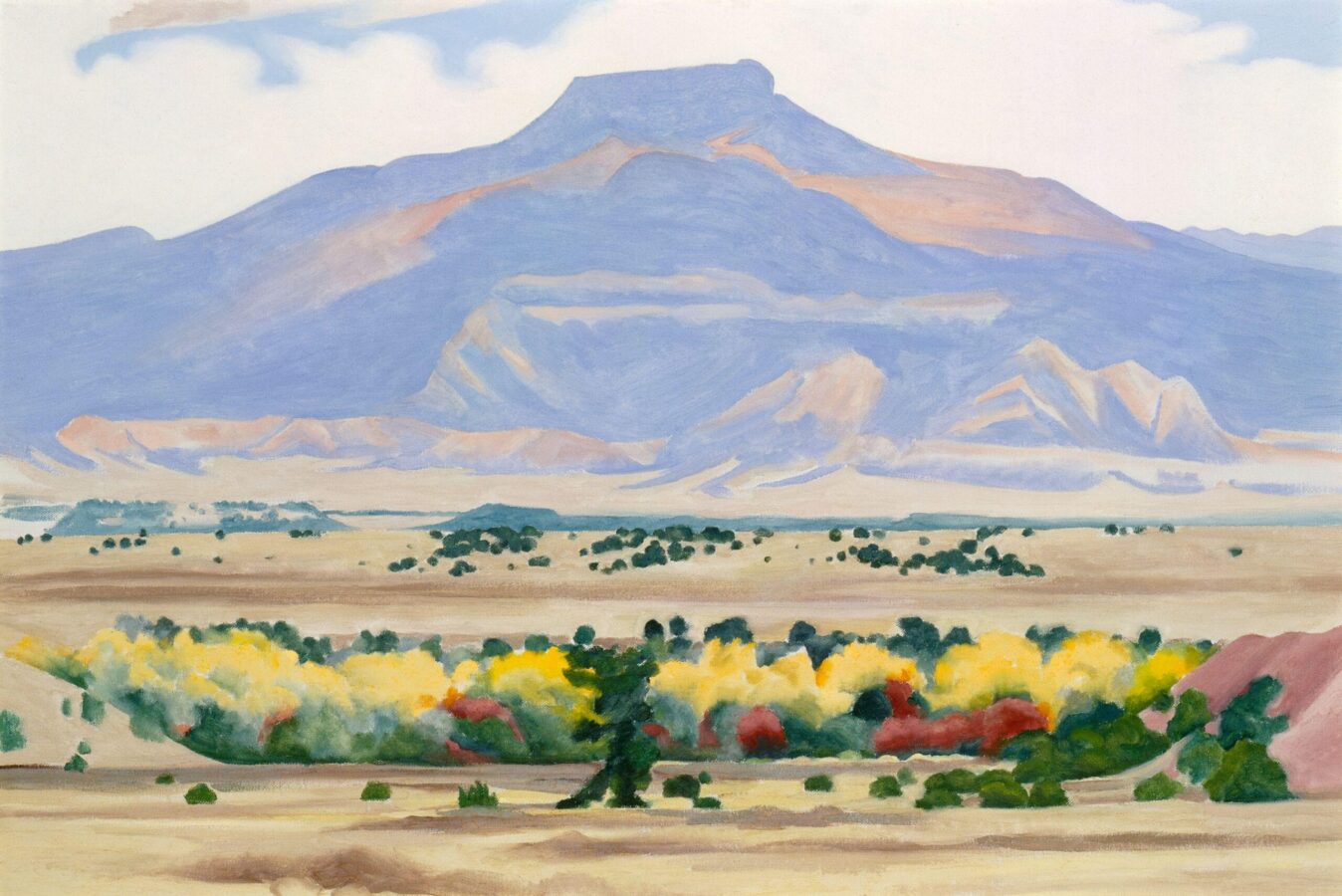
Earlier this year, I visited Tewa Nangeh/Tewa Country, an exhibition at the Georgia O’Keeffe Museum that positions works by O’Keeffe alongside contemporary works to tell a fuller picture of the New Mexico landscape that she often referenced. The show features artists, scholars, and culture bearers from the six Tewa Pueblos of northern New Mexico.
In his book Tewa Worlds: An Archaeological History of Being and Becoming in the Pueblo Southwest, Samuel Duwe describes Tewa Pueblos and their lands:
The Tewa world roughly corresponds to the physiographic province that runs along the Rio Grande Rift valley known as the Tewa Basin (Kelley 1979).… The centers of this world, or rather many worlds, are located in six small communities that have traditionally spoken the Tewa language. From north to south they are Ohkay Owingeh (formerly San Juan Pueblo), Santa Clara, San Ildefonso, Pojoaque, Nambé, and Tesuque.
Drawing awareness to the erasure of the Tewa presence in O’Keeffe’s Northern New Mexico story, this show poignantly adds to conversations around dynamics between modern art and colonialism.
While O’Keeffe spent much of her time in New Mexico, author Sascha T. Scott also explores the themes of colonialism and art in Georgia O’Keeffe’s Hawai‘i?: Decolonizing the History of American Modernism [JSTOR Article]. In this article, Scott asks readers to explore the context of O’Keeffe’s commissions for the advertising agency N. W. Ayer & Son on behalf of the Hawaiian Pineapple Company and discuss “more difficult questions about the contexts of their production, circulation, and reception” (27). This article focuses on O’Keeffe’s experience painting in 1930, but readers can create connections with the contemporary practices of artists, creatives, or content creators. When engaging in a commercial partnership, what are artists ultimately selling? What are the socioeconomic or political impacts of those products that their art sells? How do we navigate the realities that the 20 paintings O’Keeffe produced for the Hawaiian Pineapple Company both increased her audience and “served to naturalize and justify U.S. conquest” (33)?
Scott also encourages historians—and, I would argue, anyone—to “engage with Indigenous scholarship and listen to Indigenous voices and perspectives” (29) in an effort to decolonize our experience of art. Tewa Nangeh/Tewa Country is an exciting example of dissecting, interrogating, and thinking critically about art.
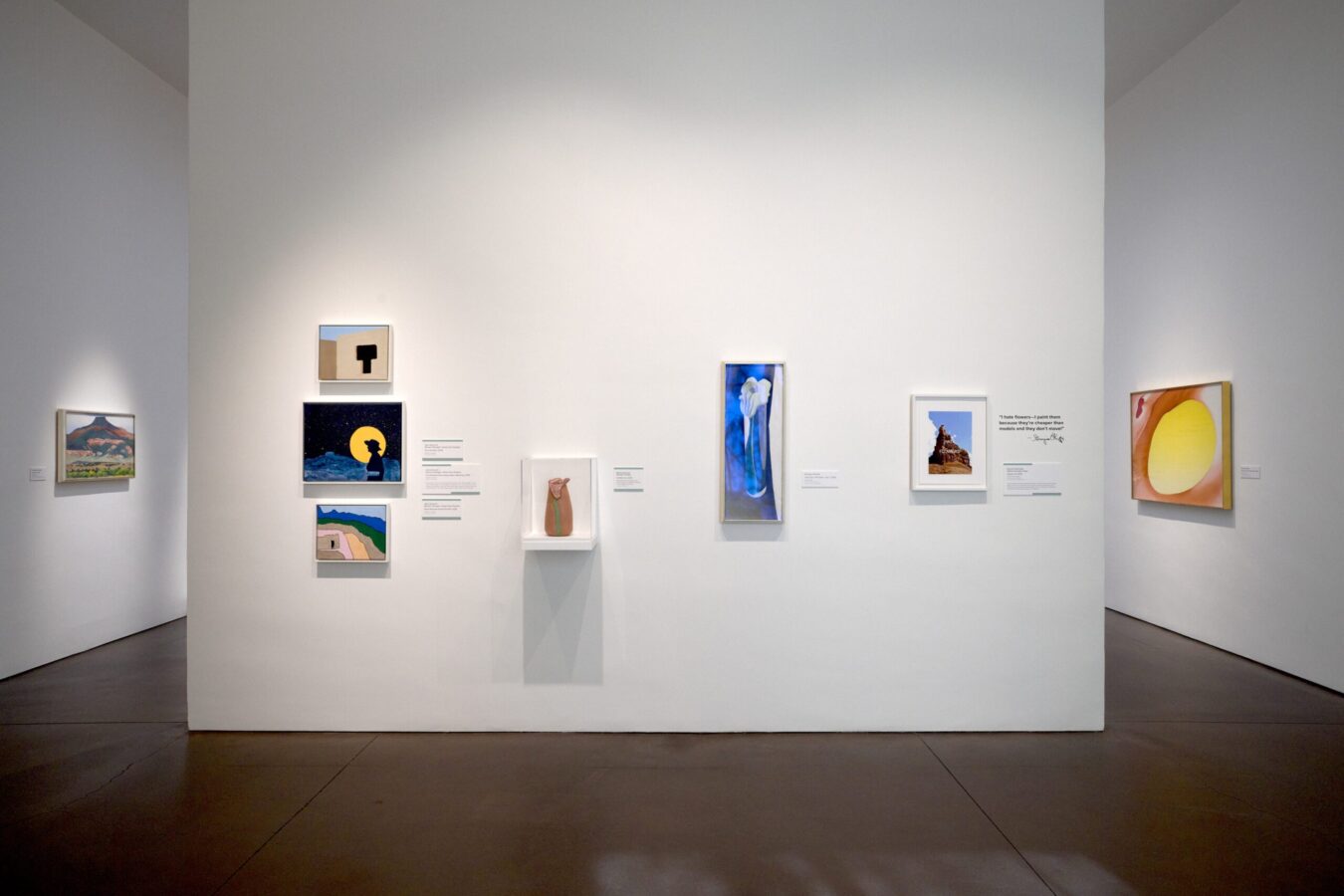
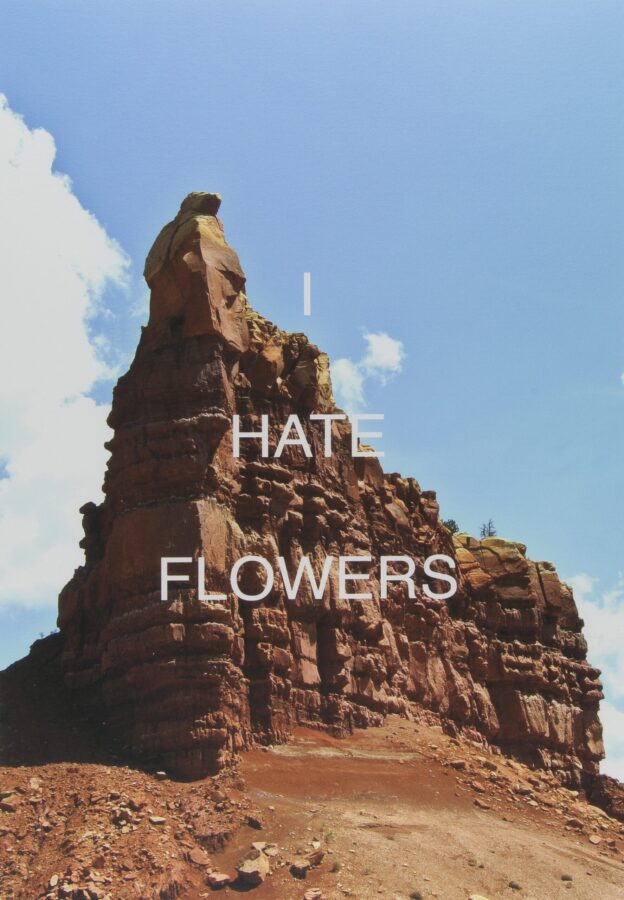
Walking through the gallery, I was drawn to the interplay between archival research and personal narrative and the ways it opens up a deeper understanding of an artist dominant in the art historical canon. For example, Michael Namingha’s Abiquiu #3 features a photo of a rock formation with “I HATE FLOWERS” layered on top. The text is taken from a longer quote from O’Keeffe: “I hate flowers—I paint them because they’re cheaper than models and they don’t move!” (from Laurie Lisle’s biography Portrait of an Artist: A Biography of Georgia O’Keeffe). Superimposing this statement on top of the landscape asks viewers to consider the land and its history in the context of O’Keeffe’s work.
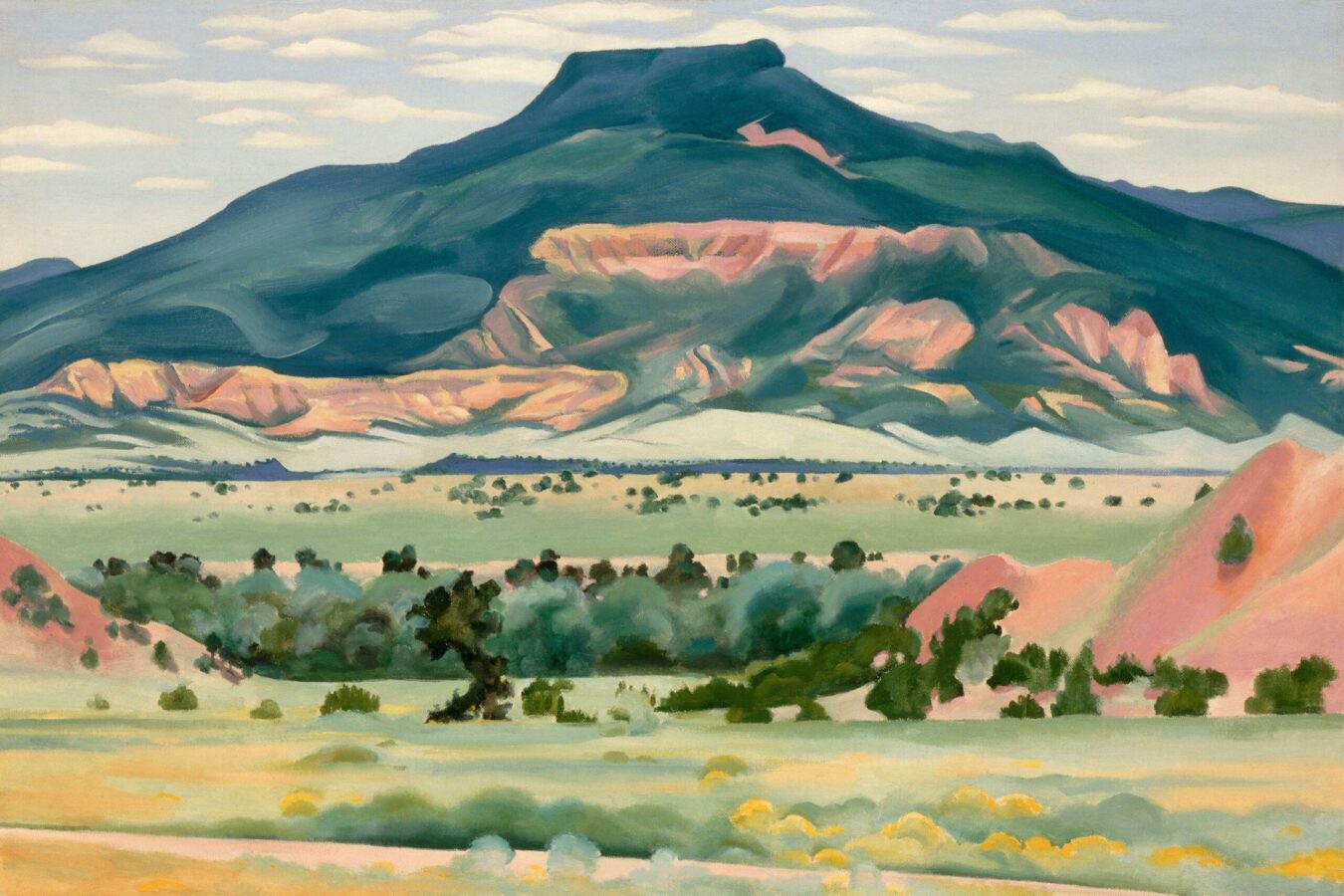
O’Keeffe’s relationship with the land, in contrast with the Indigenous perspective, was characterized by a desire to possess it. Referencing Cerro Pedernal, a mesa or flat-topped hill in northern New Mexico known by its Tewa name,Tsí Pín, O’Keeffe said in a 1977 PBS documentary, “It’s my private mountain. It belongs to me. God told me if I painted it enough, I could have it.” She even titled one painting of the mesa My Front Yard, Summer. Marita Swazo Hinds (Tesuque Pueblo) responds in the Tewa Nangeh exhibit by displaying potsherds in earth and rock from Ghost Ranch, previously O’Keeffe’s studio and summer home. Alongside the small installation Did Georgia Pray?, Hinds offers the following passage:
As potters, when we gather our clay, we pray—with our cornmeal, with our hands, with our hearts. When we create, we pray. When we fire, we pray. Every step is a conversation with the land. Each vessel holds intention, a sacred whisper molded into form.
When I think of the prayers I pour into my work, I wonder: Did Georgia pray? Did she feel a spiritual bond to this place, to the land? Did she speak to the mesas, the earth, the wind?
Did she honor this place, as we do?
The broken pot sherds represent the land, the pot, the artist, shattered yet sacred. The earth is not perfect, the form is not always whole. Even when we pray, not all things come out perfect.
Georgia once said, “It’s my private mountain. It belongs to me. God told me if I painted it enough, I could have it.
But this is Tewa Nangeh—our land!
We do not own it. We pray for it.
So, I ask again: Did Georgia pray?
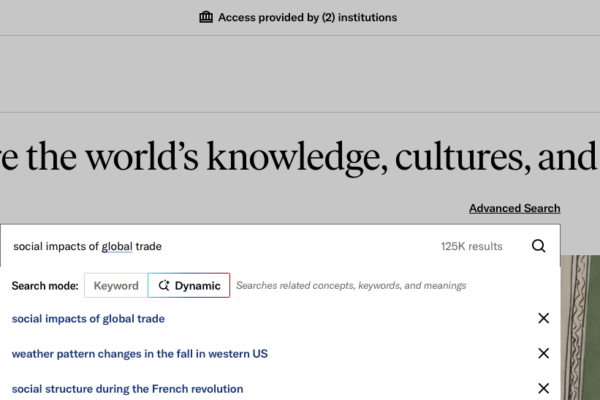
This exhibition underscores the power and importance of understanding artists’ work—and words—in the greater context of history and culture. While you browse Artstor on JSTOR’s Georgia O’Keeffe Museum collection, which includes many sketches and paintings depicting New Mexico, we invite you to take inspiration from the Tewa Nangeh/Tewa County exhibition. As you look at a work such as Sky Above Clouds I you might ask yourself whose eyes—aside from O’Keeffe’s—admired their vast beauty?
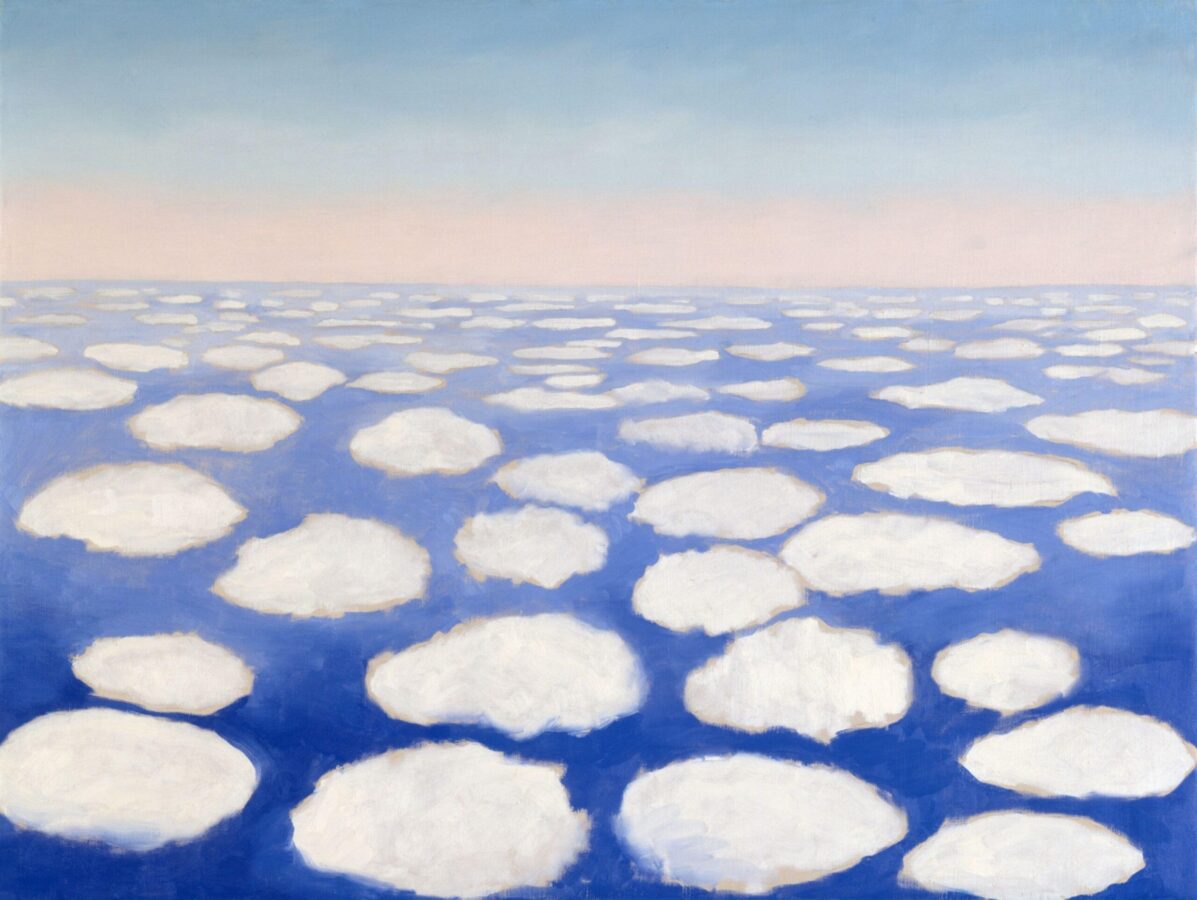
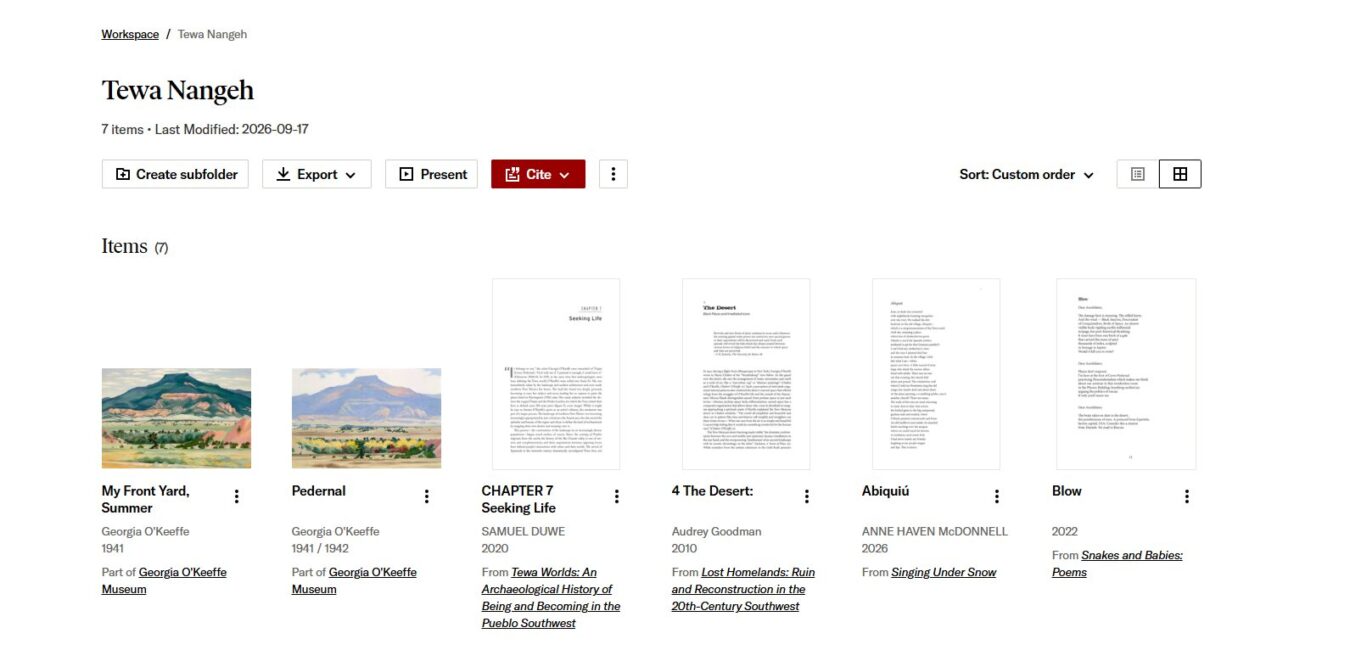
Following is a non-exhaustive list of readings that expand on the themes presented in the exhibition and offer wider insights and perspectives into the New Mexico landscape, specifically those of Tsí Pín (Cerro Pedernal), which O’Keeffe regularly painted, and Abiquiú, where O’Keeffe lived and worked for decades.
- Duwe, Samuel. “Seeking Life.” In Tewa Worlds: An Archaeological History of Being and Becoming in the Pueblo Southwest. University of Arizona Press, 2020. https://doi.org/10.2307/j.ctv103xdz6.12.
- Gibbs, Jules. “Blow.” In Snakes and Babies: Poems. Syracuse University Press, 2022. https://doi.org/10.2307/j.ctv2jn926z.10.
- McDonnell, Anne Haven. “Abiquiú.” In Singing Under Snow. Michigan State University Press, 2026. https://doi.org/10.14321/jj.36768589.10.
- Goodman, Audrey. “The Desert: Black Places and Irradiated Icons.” In Lost Homelands: Ruin and Reconstruction in the 20th-Century Southwest. University of Arizona Press, 2010. https://doi.org/10.2307/j.ctv28m3gvf.9.
- Douglass, John G., and William M. Graves. “New Mexico and the Pimería Alta: A Brief Introduction to the Colonial Period in the American Southwest.” In New Mexico and the Pimería Alta: The Colonial Period in the American Southwest, edited by John G. Douglass and William M. Graves. University Press of Colorado, 2017. http://www.jstor.org/stable/j.ctt1mmftg6.8. OPEN ACCESS
- Lewthwaite, Stephanie. “Reworking the Spanish Colonial Paradigm: Mestizaje and Spirituality in Contemporary New Mexican Art.” Journal of American Studies 47, no. 2 (2013): 339–62. http://www.jstor.org/stable/24485524.
Be sure to use JSTOR’s Workspace feature to save your multimedia items side by side for in-depth interdisciplinary research.