New tools and workflows help institutions create, review, manage, and publish meaningful, WCAG-aligned alt text at scale.
A digital image can be digitized, online, and discoverable—and yet still inaccessible to someone who cannot perceive it.
Descriptive metadata is essential for discovery, but access also depends on text alternatives that communicate what an image conveys and why it matters.
Libraries, archives, and cultural heritage institutions care for millions of photographs, artworks, maps, posters, and other visual materials they strive to make findable and usable. Descriptive metadata is essential for discovery, but access also depends on text alternatives that communicate what an image conveys and why it matters.
Creating alt text across large digital collections is work that is both necessary and difficult to scale. In developing JSTOR Digital Stewardship Services, we’re working with the library and archives community to co-create tools like JSTOR Seeklight that accelerate essential work while keeping professional expertise at the center. With support for alt text now available in Stewardship, that collaborative work moves one step further: helping institutions make collections more accessible to the communities who use them.
As a product manager and an accessibility partner for Stewardship, we see this release as both a new capability and an expression of how we believe accessibility work should be supported: with tools that extend institutional capacity, surface where expert attention is needed, and help staff apply their knowledge more consistently across large collections—without outsourcing decisions about context, meaning, or care.
Alt text is contextual
The Web Content Accessibility Guidelines (WCAG) and other established accessibility best practices frame alt text as a concise text alternative that serves the same purpose as an image and conveys the information the image provides. In practice, alt text should help someone understand what an image communicates and why it matters in the context in which it appears.
JSTOR Seeklight-created alt text is designed as a draft for expert review.
That purpose is especially important for archives and special collections, where the materiality of an object, the placement of a handwritten annotation, or the relationship between people in a photograph may carry significant historical or research value. Given these nuances, there’s rarely one objectively perfect alt text formulation, and decisions about what to include depend on myriad dynamics, from institutional practices to collection-specific context.
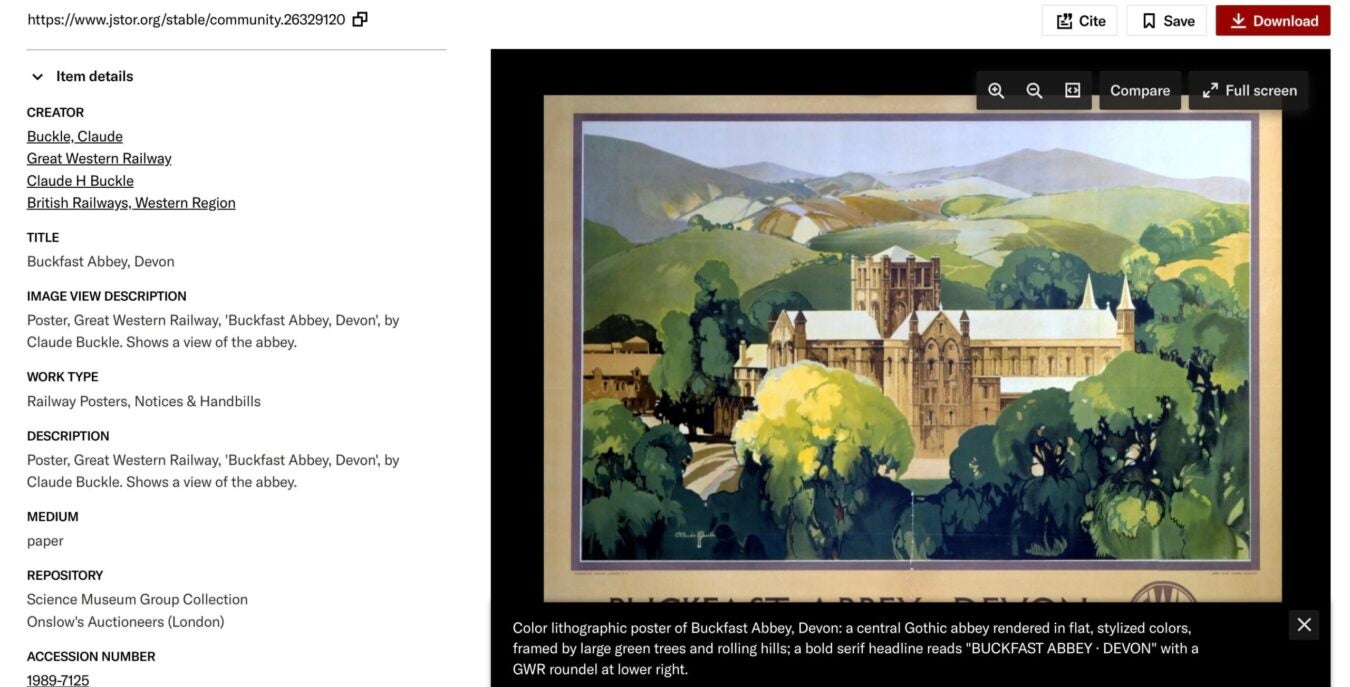
Alt text also needs to work within the context of other layers of description and access. Consider a poster with text:
- Metadata might identify the title, creator, date, subjects, and collection context.
- A transcript might provide the text elements in a machine-readable form.
- Alt text might communicate essential visual information, such as an illustration and how it relates to the text.
In concert, these layers make an item discoverable, understandable, and usable for everyone.
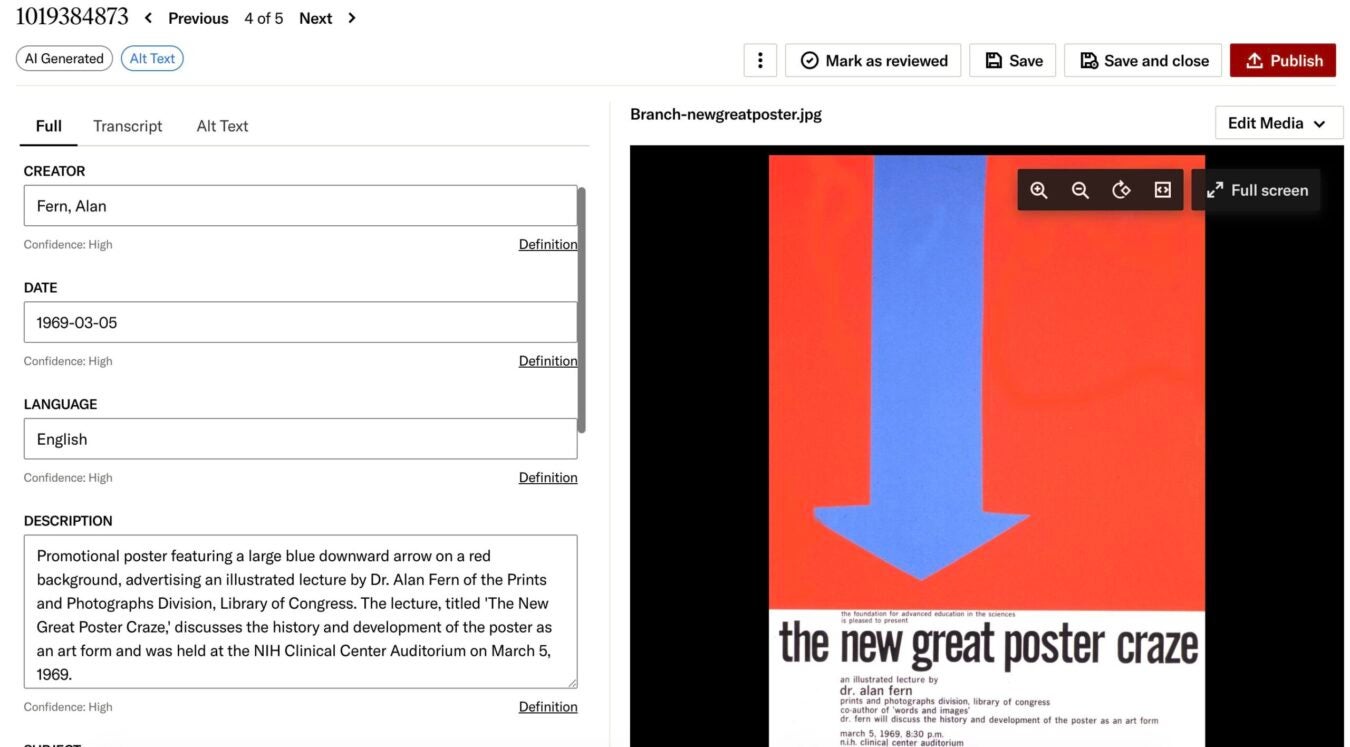
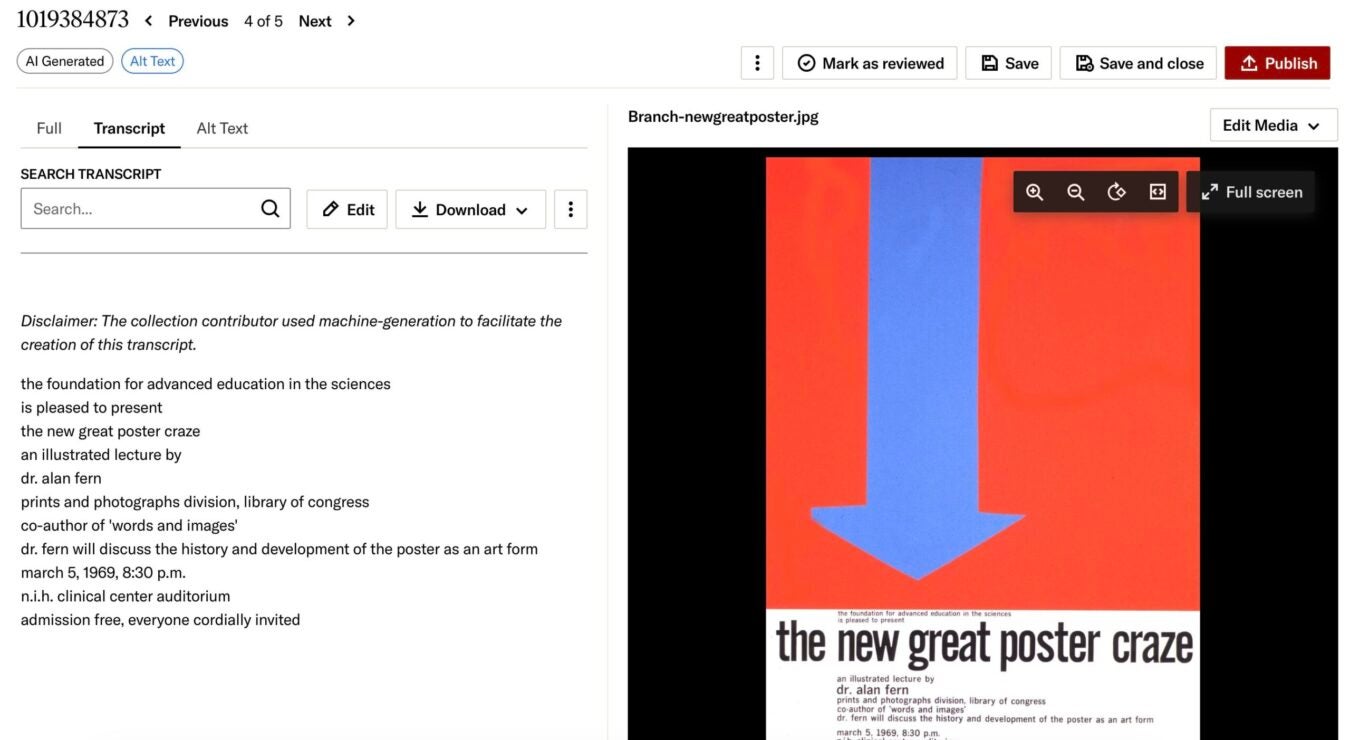
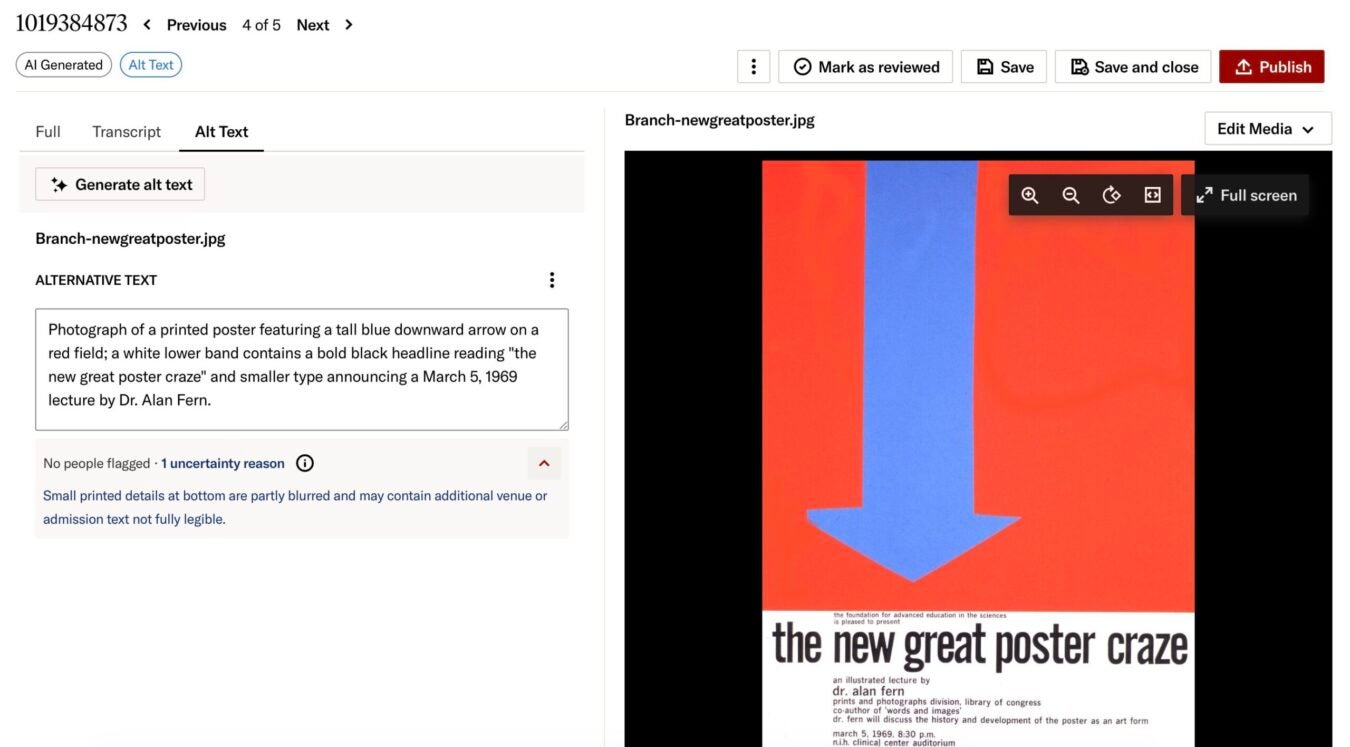
Metadata, transcripts, and alt text work together to make image-based materials more discoverable, understandable, and accessible.
Designed for review
From a technical perspective, it’s possible to generate a plausible text alternative for an image. But from an accessibility perspective, plausibility is not enough.
A description may be factually accurate but omit a key detail a researcher needs, or repeat information already available in metadata. It might interpret rather than describe, or make assumptions that can’t be established from the image alone.
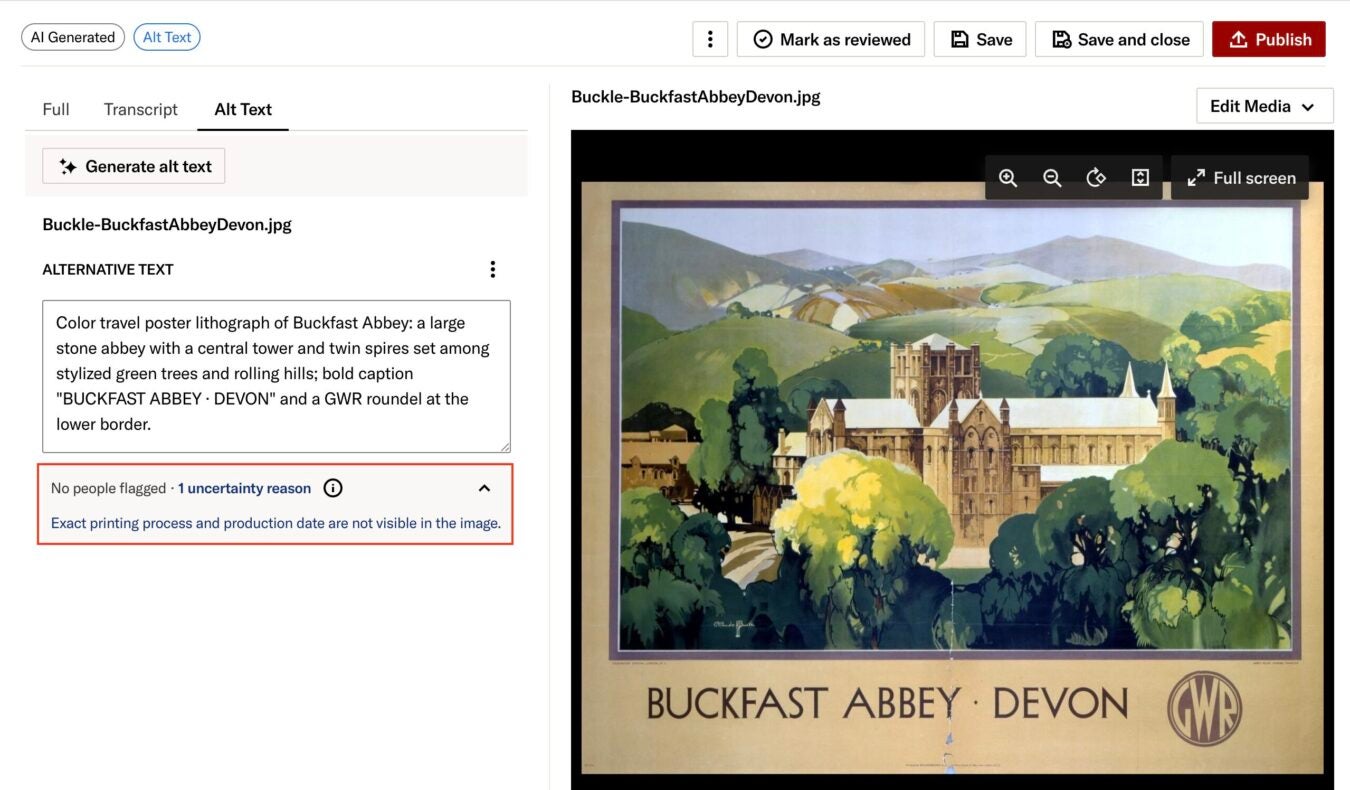
For those reasons, JSTOR Seeklight-created alt text is designed as a draft for expert review. Once generated, alt text appears alongside the item it describes within the Stewardship editing interface, where experts can refine, replace, clear, or revert it after making changes. And to help reviewers focus attention where it’s most needed, Seeklight also provides “uncertainty reasons” where relevant, identifying details that may warrant closer review, such as illegible text, partially visible elements, or unclear object identification.
Supporting thoughtful descriptions of people
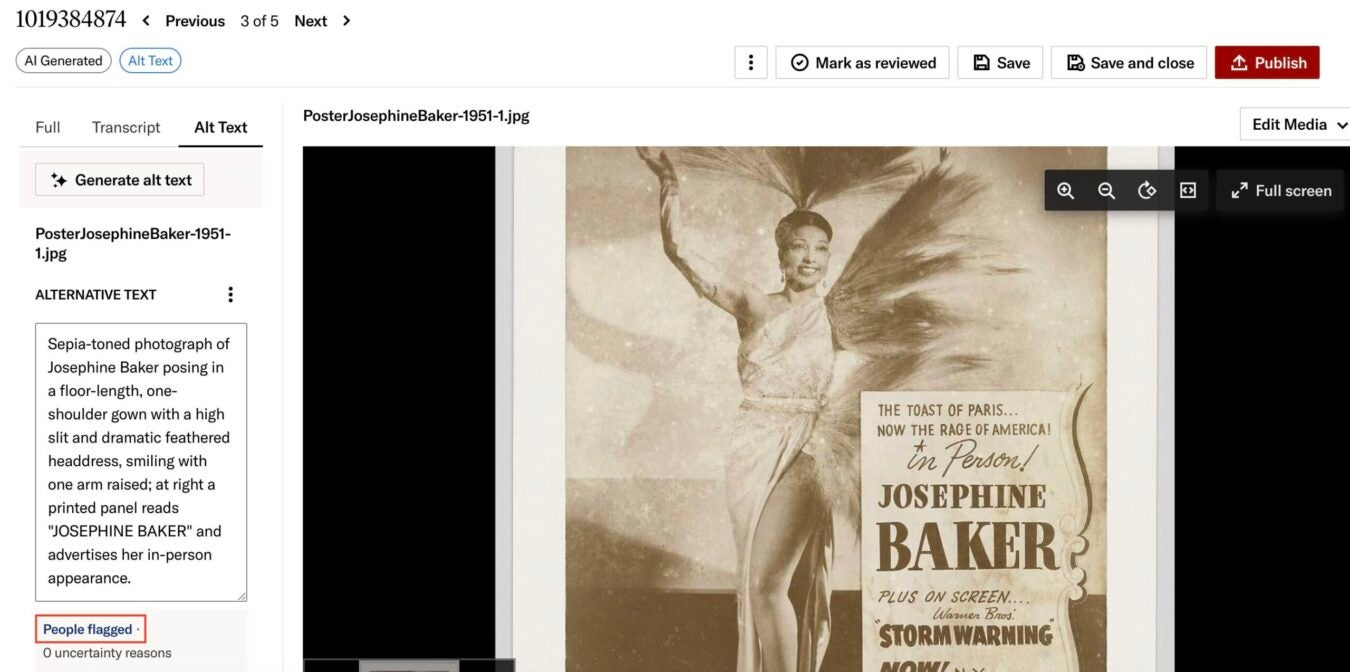
Images of people present some of the most consequential decisions in alt text.
Physical appearance can be relevant to understanding an image; omitting it can deny blind and low-vision users meaningful details available to sighted users. At the same time, describing people can introduce bias or unsupported assumptions about race, ethnicity, gender, disability, relationships, or identity. In general, objective, appearance-based language is preferable to assigning an identity that has not been confirmed, and consistency across a collection matters—but ultimately, there’s no single practice followed by every institution.
Alt text joins transcript generation to extend the same commitment further into participant-managed collections, helping institutions make images more accessible through the workflows they already use.
Because institutions may approach these questions differently, JSTOR Seeklight flags when people appear in an image without dictating how they should be described. The people flag reflects our broader approach to AI-assisted processing: surfacing moments when judgment matters most, rather than attempting to automate judgment.
Paths toward more accessible images
For Stewardship participants in Tier 2, this release provides a significant new capability: staff can author and edit alt text in the same environment where they manage collection materials and metadata. And because alt text is stored at the media-object level rather than as general item metadata, each image or page can carry its own description through Stewardship, export, and on JSTOR.
Tier 3 participants have the same authoring, editing, export, and publishing capabilities, with the addition of AI-assisted generation through JSTOR Seeklight. They can generate alt text during upload, from an individual item page, or in bulk for selected items in an existing project. Bulk generation fills empty alt text fields without overwriting descriptions that already exist.
Both paths give institutions a practical way to improve alt text coverage over time, whether they are authoring descriptions directly or using JSTOR Seeklight to create drafts for expert review. Further, this work builds on JSTOR’s broader accessibility approach: embedding accessibility across the platform—from strategy and design through development, testing, and support. The JSTOR Stewardship platform has been built from the ground up on that foundation, aligning with current accessibility standards and development practices. Alt text joins transcript generation to extend the same commitment further into participant-managed collections, helping institutions make images more accessible through the workflows they already use.
Developed through hands-on testing and user feedback
The release builds on extensive research, evaluation, design, and testing with librarians, archivists, digital collection specialists, accessibility practitioners, product designers, and engineers.
Reviewers of early prototypes found that AI-generated alt text could provide a valuable starting point, particularly when institutions face thousands—or millions—of images requiring attention. They also identified where review is essential: deciding which details matter, distinguishing description from interpretation, determining what belongs in alt text rather than metadata or a transcript, maintaining consistency, and describing people without unsupported assumptions.
These findings fundamentally shaped what we’ve developed, including the side-by-side editing experience, uncertainty reasons, and the people flag. Testing and feedback also reinforced a theme that’s consistently emerged through our work developing Seeklight in collaboration with the community: AI can accelerate work, but it cannot and should not remove the need for knowledgeable, conscientious review.
Accessibility as part of collections processing
When we first introduced JSTOR Seeklight, metadata generation was its primary capability, but our longer-term vision was broader: a collections processing tool that could help institutions make digital collections discoverable, accessible, and usable. We’ve continued to expand in that direction, first through transcripts and now through alt text.
That progression reflects an important idea: collections processing is not linear, and it’s not finished once an item is online. Collections may need to be revisited as accessibility expectations evolve, previously inaccessible text becomes transcribable, or approaches to description are reconsidered. New technology can help institutions undertake that work at greater scale while keeping professional context and judgment at the center.
Alt text extends that approach to image accessibility, giving institutions another way to improve collections over time and helping more people encounter, understand, and learn from the materials they steward.
Learn more
Support for alt text is available today for all Tier 2 and Tier 3 participants in JSTOR Digital Stewardship Services, and Tier 3 charter participants can use JSTOR Seeklight to generate draft alt text for individual items or in bulk. Interested in learning more? Get in touch with our team!