
Teaching
-
By Joseph Costello, Medical Librarian, Western Michigan University Homer Stryker M.D. School of Medicine Prompt: Imagine the human expression of anguish. An amalgamation of stories, artwork, and social interactions blend together and you have your general concept of the human expression: anguish. The concept of anguish is correct to you since it is, after all,…
-
Next week we will offer Teaching Global Contemporary Art in AP® Art History, the second in our series of occasional webinars on works of art and architecture in the AP® Art History curriculum. To help us navigate this topic, we have enlisted art historian Dr. Virginia Spivey as our guest presenter. Dr. Spivey specializes in…
-
By Katy Matsuzaki, Manager of Academic Programs, New Britain Museum of American Art Recently a group of docents at the New Britain Museum of American Art gathered in a gallery filled with landscapes and portrait paintings to discuss how they might approach the art with a middle school math class scheduled for a visit. As they…
-
As we built our AP® Art History Teaching Resources over the last three years, we found ourselves fascinated by some of the newly required content. The art of the Colonial Americas is represented in the curriculum framework by six distinct objects. One of these is the “Codex Mendoza,” named for the first viceroy of Mexico…
-
Good news for English instructors: We have four new Curriculum Guides–collections of images from the Artstor Digital Library based on syllabi for college courses–covering different aspects of English Literature, each created by experts in the field: British Romantic Poetry by Hugh Roberts, Associate Professor of English at the University of California, Irvine Gender in Restoration and Early…
-
I continue to be amazed by the possibilities for teaching the new Advanced Placement® Art History Curriculum with Artstor. As we gather images to place in our growing AP® Art History Teaching Resources and draft the accompanying essays and links, I sometimes pause to marvel at how the curriculum interconnects. Those key works of art and…
-
I continually come across astounding images when crafting our resources for use in the AP® classroom; they serve as a reminder that a work of art is often subjected to dramatic events. Moreover, that these images stem from so many different places underlines the special value of the Artstor Digital Library. Recently, in gathering the 24 images to support the teaching of Leonardo’s Last…
-
Artstor is introducing curriculum guides–collections of images from the Artstor Digital Library based on syllabi for college courses–compiled by faculty members and experts around the country. Learn more here. Survey of Western Art 2: Renaissance to Postmodern Nancy Minty, Ph.D, Collections Editor, Artstor This curriculum guide consists of a thorough overview of later western art (approximately…
-
Artstor is introducing curriculum guides–collections of images from the Artstor Digital Library based on syllabi for college courses–compiled by faculty members and experts around the country. Learn more here. Survey of Western Art 1: Prehistoric to Gothic Nancy Minty, Ph.D, Collections Editor, Artstor This curriculum guide covers a comprehensive introduction to early western art (approximately 30,000…
-
Artstor is introducing curriculum guides–collections of images from the Artstor Digital Library based on syllabi for college courses–compiled by faculty members and experts around the country. Learn more here. Shakespeare: Text and Performance Julia Reinhard Lupton, Professor, English, University of California, Irvine This curriculum guide focuses on three plays: Romeo and Juliet, Twelfth Night, and Cymbeline. The…
-
Artstor is introducing curriculum guides–collections of images from the Artstor Digital Library based on syllabi for college courses–compiled by faculty members and experts around the country. Learn more here. History of Architecture and Urbanism I Amber Wiley, Visiting Assistant Professor, Architecture, Tulane University This curriculum guide is global in focus, including both Western and non-Western developments,…
-
Artstor is introducing curriculum guides–collections of images from the Artstor Digital Library based on syllabi for college courses–compiled by faculty members and experts around the country. Learn more here. Introduction to Philosophy Carl Hammer, Lecturer, Communication Studies, University of MN, Twin Cities This curriculum guide introduces the student to the basic problems, methods and theories of…
-
Artstor is introducing curriculum guides–collections of images from the Artstor Digital Library based on syllabi for college courses–compiled by faculty members and experts around the country. Learn more here. Colonial Latin America curriculum guide Rachel Moore, Associate Professor, History, Clemson University This curriculum guide explores a wide range of perspectives on the colonial period in Latin America.…
-
Navigating the tremendous number of images in the Artstor Digital Library can be daunting, particularly to those in fields outside of art history. Where to start looking for images for, say, an Introduction to Philosophy class? To address that hurdle, we are introducing curriculum guides – collections of images from the Artstor Digital Library based…
-
The mission of Aalto University is to create a new science and arts community. In this video, chief information specialist Eila Rämö explains how Aalto uses Artstor.
-
By Mark Branner, University of Hawaii, Manoa I have the great privilege of teaching an introductory college-level course on puppetry. Even though it is an introductory course, it is actually classified as an upper division course, which means that I generally have juniors and seniors straggling in, looking for an easy “basket-weaving” escape. There are…
-
Artstor’s AP® Art History Teaching Resources support the revised Curriculum Framework for the Advanced Placement® Art History course. The image groups and accompanying essays will eventually cover all 250 key works of art and architecture required for AP® Art History courses. Along with the Digital Library’s 1.8 million images, the project enhances classroom teaching in preparation…
-
Gregory K. Martin, Ph.D. Upper School Director, La Jolla Country Day School In a compelling study of Western United States history, Patricia Nelson Limerick quotes Nannie Alderson, a former Virginian who moved to Montana in 1883. Alderson, looking back on a unique feature of her experience, recollected that there was on the frontier an abundance of cans:…
-
When I first joined Artstor, it was from the perspective of an art history and humanities teacher. In my own little niche, the Artstor Digital Library was what one friend called “the candy store for art historians.” As I familiarized myself with the wide array of candy available, I was also building my understanding of…
-
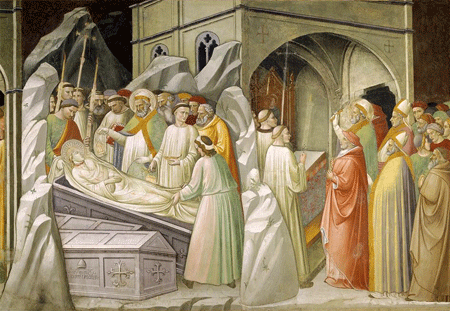
Anne C. Leader, Professor, SCAD-Atlanta While the primary motivation for patrons of religious architecture and decoration was to gain or retain God’s grace, Florentine tomb monuments manifest a conflicting mix of piety and social calculation, reflecting tension between Christian humility and social recognition. Though some city churches still house many tombs, most of the thousands of…
-
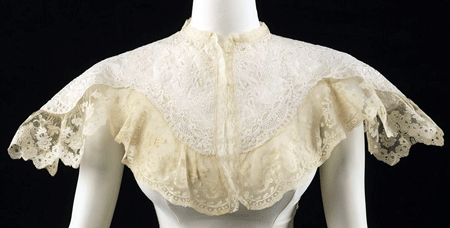
Lisa Hartley, Columbus College of Art Design The small town of Chantilly, France, is home to Chantilly Castle, an architectural wonder of sandstone, antiquated fountains, and enchanting gardens. Here is where lace, my research niche and mild obsession, takes center stage. The traditions and skills used in lacemaking date back to early as the 16th…
-
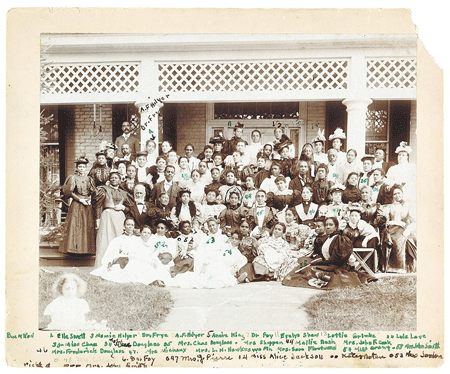
Amber N. Wiley, Ph.D. , Visiting Assistant Professor of Architecture, Tulane University Historian Constance Green characterized Washington, D.C. in the early 1900s as the “undisputed center of American Negro civilization” in her 1969 book Secret City: History of Race Relations in the Nation’s Capital. This was America before the Harlem Renaissance, in which the average percentile…
-
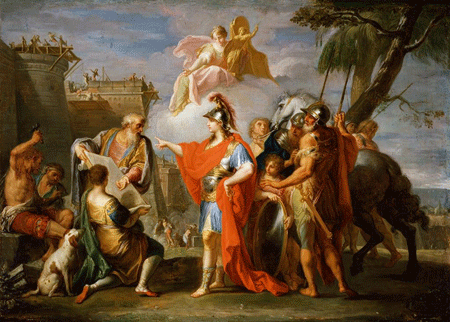
Marlene Nakagawa, Undergraduate student at the University of Oregon During his ongoing series of campaigns, Alexander the Great founded or renamed nearly twenty cities after himself. From Pakistan to Turkey, these cities stood as a representation (as if one was necessary) of his omnipresence in the ancient world. Over the centuries, most of the Alexandrian cities…
-
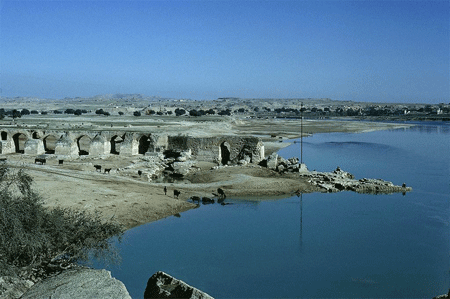
Peyvand Firouzeh, PhD Candidate, University of Cambridge Aridity in the Islamic world stands in contrast to the well-known landscape architecture of Islamic gardens, where water is used generously and luxuriously. The contrast hints at creative methods of dealing with water scarcity: from man-made canals and reservoirs to cisterns and qanats (subterranean tunnel-wells), examples of which can…
-
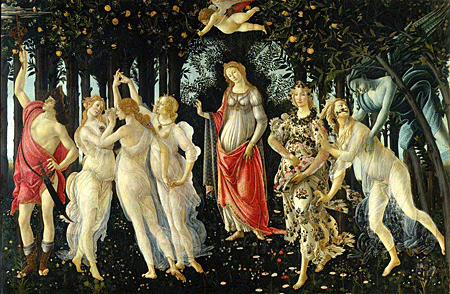
Spring is here! The return of sunshine inspired us to look at Botticelli’s Primavera, a masterpiece of the early Renaissance and arguably the most popular artistic representation of the season, even if – as we shall see – its interpretation remains inconclusive. Botticelli painted Primavera sometime between 1477 and 1482, probably for the marriage of…
-
By Dana Howard True confession: I was a sporadic—and inattentive—user of the Artstor Digital Library. My high school was a fairly early adopter of Artstor. I used it a lot on those early years, but as I had more and more of my slides “in the can,” I stopped paying attention to the changes taking place…
-
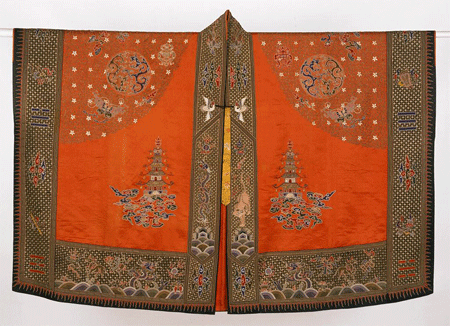
By Rachel Pollock, University of North Carolina at Chapel Hill Artstor helps me surmount a primary difficulty in teaching historical hat-making to my graduate students in theatrical costume production: diverse visual examples of our topics. In millinery class, we consider not only styles and materials from which hats are made, but also their history—the provenance and…
-
Mrs. Michelle Apotsos Stanford University Doctoral candidate Art History/Architectural History As a graduate student at Tufts University, I was once given the opportunity to give a lecture to a class of architectural history students on West African architectural form for the purpose of unsettling some common notions that inform Western conceptions of the built environment.…
-
Margaret Teillon Volunteer educator Wachovia Education Resource Center, Philadelphia Museum of Art From a very early age children love to read, be read to, and look at pictures in books. Recognizing the joy children bring to picture books, I have developed teaching materials using selected children’s literature combined with Artstor images. My goal is to…
-
Amelia Nelson Cataloging and Digital Services Librarian Kansas City Art Institute In the spring semester the library collaborated with the Fibers Department by hosting 500 growing silkworms in one of the display cases at the library entrance. The worms were grown as part of the course “Fiber History and Properties.” The silkworms’ development was tracked…

Sign up for updates
Never miss a thing. Get updates from JSTOR delivered straight to your inbox.
By signing up you agree to our Privacy Policy. You may unsubscribe at any time by clicking on the provided link on any marketing message.
"*" indicates required fields