
Artstor on JSTOR
-
The Larry Qualls Archive of Contemporary Art surveys almost three decades of work exhibited in the New York area from 1988-2012. In this post, we consider the personalities and forces that dominated the art world in the 2000s. See also the 1980s and the 1990s. The beginning of the 21st century was an especially auspicious…
-
The Larry Qualls Archive of Contemporary Art surveys almost three decades of work exhibited in the New York area from 1988-2012. In this post, we consider the personalities and forces that dominated the art world in the 1990s. See also the 1980s and the 2000s. As curator Gary Carrion-Murayari pointed out, the 1990s had a…
-
The Larry Qualls Archive of Contemporary Art surveys almost three decades of work exhibited in the New York area from 1988-2012. In this post, we consider the personalities and forces that dominated the art world in the 1980s. See also the 1990s and the 2000s. Quall’s collection opens during the hurly-burly of the 1980s, the…
-
According to a 1985 Illustrated London News poll of artists and critics, Diego Velázquez’s Las Meninas was voted the world’s greatest painting. Let’s take a close look at the painting, its history, and the emotions it elicits to pinpoint why.
-
When it comes to modern warfare, we’ve seen so much through photographs: mass graves, explosions, the faces of soldiers the instant they’re shot. And we’ve also seen the aftermath of war–devastated landscapes, soldiers carrying their dead, and returning home to their families. We’ve become accustomed to a depth of visual coverage that has brought deep…
-
Our friends at JSTOR Daily remind us that this year marks the centennial of the cacophonous beginnings of the Dada movement in Zurich’s Cabaret Voltaire. An anarchic response to the ravages of World War I, the movement is notoriously difficult to pin down. Matthew Wills writes, “Dada combined absurdity and nonsense, radical politics and anti-politics,…
-
Armistice Day became Veterans Day in the United States in 1954. While the holiday is also known as Remembrance Day in other countries and celebrates the end of World War I, the name change in the United States reflects its emphasis on honoring military veterans. The two objectives were mentioned in a speech on the…
-
Take a deep breath, the presidential debates are finally over. But brace yourselves, we still have a couple of weeks of campaigning left until the actual elections. Why the negative tone? Well, the Washington Post reported that “59 percent of Americans are sick and tired of the election”–and that was way back in July! And…
-
In 1862, amateur photographer William H. Mumler of Boston took a self-portrait in his studio, unaware of a ghostly apparition lurking directly behind him. It wasn’t until he viewed the resulting image of a pellucid arm draped casually across his shoulder that he realized the camera must have exposed the lingering spirit of his deceased…
-
An interview with the graduate student curators of Avery/GSAPP Architectural Plans and Sections To celebrate the completion of our two-year collaborative project with Avery Library and GSAPP on releasing a collection of 20,000 architectural plans, sections, and related materials in Artstor, Lisa Gavell, Artstor’s Senior Manager of Metadata & Content, spoke with five of the…
-
In 1846, dentist William T. G. Morton assembled a group of doctors in the operating theater at Massachusetts General Hospital, a sky-lit dome located on the hospital’s top floor. As the doctors watched from the dome’s stadium seating, Morton waved a sponge soaked in a mysterious substance called Letheon inches from his patient’s face. The…
-
Professor David S. Efurd’s collection of nearly 10,000 photographs of Buddhist, Hindu, and Jain art and architecture was recently released in Artstor. We were particularly impressed by the variety and complexity of the rock-cut cave temples he photographed, and he was kind enough to answer our questions. Artstor: What is the importance of caves as the sites of some…
-
Sculptor Benvenuto Cellini is best remembered for two things: his bombastic autobiography, the Vita, in which he confesses to multiple murders and a spectacular jailbreak, and for his salt cellar. Yes, that’s right—a dish for salt.
-
We are introducing a new resource featuring more than 75 images on the topic of biomimicry. Find it in the Artstor Digital Library’s Teaching Resources area: Teaching Resources > Case Studies > STEM to STEAM > Stem to Steam: The Anatomy of Design Throughout history we have looked to nature to define and devise systems…
-
These photographs of six members of the American Museum of Natural History (AMNH) Paleontology staff sitting inside the massive jaws of a Carcharocles megalodon are the stuff of nightmares—and, of course, just the thing for Shark Week. Yet, as Brian Switek writes on ScienceBlogs, they’re the result of a miscalculation. “[T]he famous jaws were reconstructed by…
-
We invited Barbara Anello to tell us about her photographs of graffiti in Lower Manhattan, newly released in the Artstor Digital Library. I photographed graffiti, stencil art, wall paintings, and murals on New York City streets during the 1980s and early ’90s in Lower Manhattan from about 14th Street south to Battery Park, and from the Hudson…
-
On May 5th, Merete Sanderhoff, curator and senior advisor at the National Gallery of Denmark (Statens Museum for Kunst), presented “Sharing is Caring” (you can see her slides here) at the Artstor offices for a group of professionals in the arts and cultural heritage fields, as well as members of the American Friends of SMK.…
-
On his famous three voyages to the South Seas, British explorer Captain James Cook charted the largely unexplored Pacific Ocean, achieved the first recorded European contact with the eastern coastline of Australia and the Hawaiian Islands, and completed the first recorded circumnavigation of New Zealand. But Cook’s nautical feats are only part of the story; of…
-
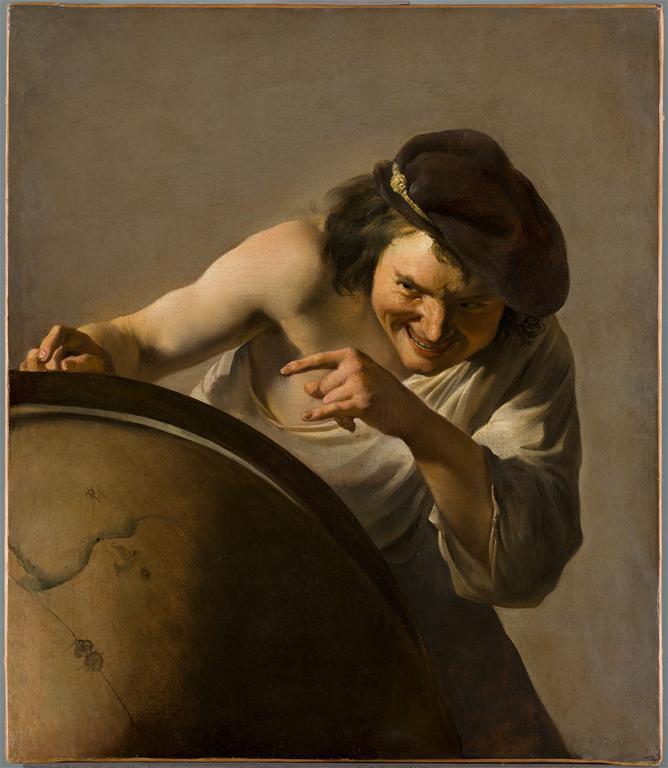
Democritus is primarily remembered for theorizing that all matter consists of particles called atoms, and this stunning quote: “Nothing exists except atoms and space, everything else is opinion.” The Short History of the Atom wiki summarizes Democritus’ theory nicely: All matter consists of invisible particles called atoms. Atoms are indestructible. Atoms are solid but invisible. Atoms…
-
To celebrate Artstor’s collaboration with the RISD Museum, our friends at the museum graciously created a lightning-tour of their encyclopedic collection in the Digital Library through twenty notable objects. Part one focuses on decorative and utilitarian artifacts, and part two on artworks. Aphrodite This bronze figure of Aphrodite, now green from oxidation, once would have…
-
To celebrate Artstor’s collaboration with the RISD Museum, our friends at the museum graciously created a lightning-tour of their encyclopedic collection in the Digital Library through twenty notable objects. Part one focuses on decorative and utilitarian artifacts, and part two on artworks. Paint Box Only a handful of paint boxes survive from ancient Egypt, and…
-
If you’re still trying to adjust to the start of Daylight Saving Time, we’d like to give you a little bit of advice: don’t let the mythological gods of Greece and Rome catch you napping. Seeing mortals sleeping seems to bring out the worst in them. Here are three of the most notorious examples: Endymion…
-
As we built our AP® Art History Teaching Resources over the last three years, we found ourselves fascinated by some of the newly required content. The art of the Colonial Americas is represented in the curriculum framework by six distinct objects. One of these is the “Codex Mendoza,” named for the first viceroy of Mexico…
-
Frida Kahlo is world-famous for her self-portraits, which were a big part of her relatively small oeuvre (55 out of 144 paintings), while her husband Diego Rivera, despite producing much more work than Kahlo, only painted himself approximately 20 times. Why is that?
-
No doubt you are familiar with the work of the renowned wildlife artist John James Audubon, most likely his famous prints from The Birds of America. But did you know he wasn’t the only artist in the family? His son, John Woodhouse Audubon, spent much of his career supporting the work of his father, but he made a valuable…
-
Kenyon Cox (1856-1919) might now be best remembered for his murals in the Library of Congress, as well as in the state capitol buildings of Des Moines, St. Paul, and Madison, but he was also a respected writer and influential teacher. In 1911, he delivered a series of lectures on painting at the Art Institute of…
-
We’ve gathered six examples that illustrate how the images in Artstor can be used to enhance the teaching and learning of architecture and architectural history, along with two case studies, one by a then-doctoral candidate and another by a fine art faculty member. Recent photographs released by the militant group Islamic State in Iraq and…
-
There’s hidden sweetness in the stomach’s emptiness. We are lutes, no more, no less. If the sound boxes stuffed full of anything, no music. If the brain and belly are burning clean with fasting, every moment a new song comes out of the fire. – Molana (Rumi), Ghazal No. 1739 from Divan-e Shams-e Tabriz This…
-
To the pioneers of Minimalism, Agnes Martin’s grid paintings were an early source of inspiration. To the Abstract Expressionists, Martin was a peer, whose use of line to cover canvases from edge to edge was not a gesture of Minimal art, but an expression of the AbEx concept of “allover” painting. In her own words,…
-
In addition to still images, you can find videos, audio files, 3D images, and panorama (QTVR) files within the Artstor Workspace. You can search by media type using the file extensions as keywords: Videos – search for mov. Clicking the movie icon will open your default video player. Audio – search for mp3. Clicking the…
Sign up for updates
Never miss a thing. Get updates from JSTOR delivered straight to your inbox.
By signing up you agree to our Privacy Policy. You may unsubscribe at any time by clicking on the provided link on any marketing message.
"*" indicates required fields