How are library accessibility leaders preparing for upcoming ADA Title II requirements—and what support do they need from content providers and digital collections tools to make progress sustainable?
To answer this question, I conducted qualitative research interviews with accessibility experts at seven public colleges and universities across the United States in early 2026. While April’s ADA Title II requirements for public institutions are a particular priority for U.S. campuses, accessibility expectations are increasingly global, with similar requirements already in place or taking shape in other regions.
My research focused on two connected areas: what institutions need from scholarly content providers, and the day-to-day realities institutions face in making digital archives and special collections accessible.
The interviews were practical, candid, and forward-looking, offering a directional snapshot of how accessibility leaders are thinking right now. What stood out most was not alarm over an impending regulation change, but focus on steady, sustainable progress, alongside a sense of mission-driven energy around work that aligns closely with library values. These findings reflect patterns we’ve seen across other user research and community conversations.
Here are a few themes that came through consistently in these interviews, along with what they may signal for the broader scholarly ecosystem.
Libraries feel steady, even as urgency rises elsewhere
While accessibility mandates are creating anxiety in some corners of campus, libraries are often among the most prepared groups within their institutions. Many are already embedded in accessibility committees, training faculty, reviewing digital tools, and auditing content.
There is broad recognition that full, immediate retroactive remediation of legacy materials is not realistic. Instead, many teams are working through what accessible practice looks like within the context of campus realities, especially when the volume of legacy content is large, and resources are limited.
That steadiness doesn’t mean the work is easy. It means the work is planned, and increasingly framed in terms of demonstrable progress, prioritization, and clear procedures, rather than an assumption that everything can be remediated immediately.
Prioritization is the norm, not the exception
When we asked how institutions are approaching accessibility at scale—especially for digital archives and special collections—prioritization came up in nearly every interview. In fact, prioritization has been a consistent theme across dozens of conversations informing the design of JSTOR Digital Stewardship Services. Frameworks for prioritization typically include:
- Newly published or newly posted content should be accessible by default
- Course-related and high-use materials take priority
- Legacy materials are addressed based on demonstrated need
- Access-upon-request models remain part of the strategy for lower-use materials
This approach reflects real institutional constraints such staffing, funding, and scale, and mirrors how many scholarly platforms are tackling large legacy backfiles. The goal is not perfection overnight, but meaningful access in practice.
At the same time, institutions expressed a strong desire to ensure that access does not depend solely on where content falls in a queue. This tension between practical prioritization and immediate user need is shaping how vendors and platforms think about scalable solutions.
Speed and transparency from content and service providers matter
In terms of expectations from the content and service providers libraries rely on, institutions repeatedly emphasized the same things: responsiveness, clarity, and evidence of sustained progress.
The majority of accessibility leaders we’ve spoken with are not expecting instantaneous perfection from providers. They recognize that legacy content and complex media introduce real challenges, but when accessibility issues arise—particularly for course materials—responsiveness matters. Just as important as speed is transparency. Accessibility leaders do not want to chase down documentation, or interpret vague claims.
What they are looking for is:
- VPATs and other documentation that is current, specific, and easy to find
- Disclosure of known limitations paired with transparent roadmaps for improvement
- Defined remediation pathways with realistic, reliable turnaround expectations
Providers who communicate clearly and demonstrate continuous improvement are viewed as strong partners. For institutions balancing regulatory risk, accessibility policy, and their mission-driven commitment to equitable access, accessibility performance increasingly factors into renewal conversations, and long-term relationships with providers.
Those who are opaque or vague create additional burden for already stretched teams.
AI is becoming part of the solution—with oversight
Feedback from our research interviews shows growing interest in AI-assisted accessibility tools. This interest is often coupled with appropriate caution, especially among stewards of digital archives and special collections who are navigating substantial remediation backlogs. Institutions emphasized the importance of efficient, scalable solutions, as manual remediation of hundreds of thousands of legacy items is not operationally viable.
AI-generated captions were broadly regarded as acceptable, provided the mechanisms for review or monitoring are in place to address errors. Similarly, AI-generated alt text was viewed as a useful starting point rather than a complete solution, with human review remaining essential to mitigate the risk of bias, inaccuracy, or misrepresentation.
Across discussions, participants consistently underscored the critical role of human oversight. Clear disclosure of AI usage, coupled with indicators of (and pathways for) human review, were identified as preferred practices.
How JSTOR is applying these insights
The accessibility leaders we spoke with are pragmatic. They are prioritizing high-impact materials, seeking scalable solutions, and expecting their content and service providers to communicate clearly, respond quickly, and demonstrate progress.
We know experiences and perspectives vary across institutions, but our research and community engagement offer useful signals about where expectations are sharpening, where constraints remain, and help us prioritize where to focus our work. At JSTOR, we are focused on three things:
1. Clear, proactive communication.
We’ve updated our accessibility page to provide a central place for documentation, standards, and updates, including the latest JSTOR platform VPAT and the newly released JSTOR Digital Stewardship Services VPAT. As institutions prepare for April and beyond, we want our approach to be easy to find and understand.

The updated accessibility page was independently reviewed in February 2026 through the ASPIRE accessibility review framework, where JSTOR was awarded a 100% ASPIRE Gold rating. This re-verification follows our original 2021 review and reflects substantial updates to our accessibility communications, not just maintenance.
The review recognized our mission-driven framing, transparent auditing practices, clear documentation of reading options and DRM-free status, and the introduction of scalable solutions, such as on-demand remediation, and transcript generation through JSTOR Seeklight.
2. Scalable access across the full JSTOR platform.
One of the most persistent challenges in academic platform accessibility is the legacy backfile. This content was often created decades ago, long before modern standards existed. Institutions told us clearly that prioritization is necessary, but so is ensuring that access does not depend solely on whether content has already been remediated.
In our recent accessibility update, Beth LaPensee described the principle guiding this work:
“At JSTOR, our goal is simple: no matter which item someone needs—whether it’s new, old, or rarely used—they should be able to access, read, and use it when they need it.”
That user-centered commitment is what underpins our introduction of on-demand remediation capabilities. The goal is to support access across the full platform, while continuing broader accessibility improvements over time.
3. Investing in sustainable, workflow-integrated, and human-centered solutions
Institutions consistently emphasized the need for scalable tools that reduce manual remediation burdens and fit into existing workflows. Rather than relying solely on one-off fixes, accessibility must be integrated into how content is created, managed, and delivered over time.
At JSTOR, accessibility by design means considering access at every stage of how we develop and support our platform and services. Our on-demand remediation capabilities help ensure access to materials at jstor.org. At the same time, through JSTOR Digital Stewardship Services, we embed accessibility into digital archives and special collections workflows from the outset, shaping how materials are prepared, processed, preserved, and shared.
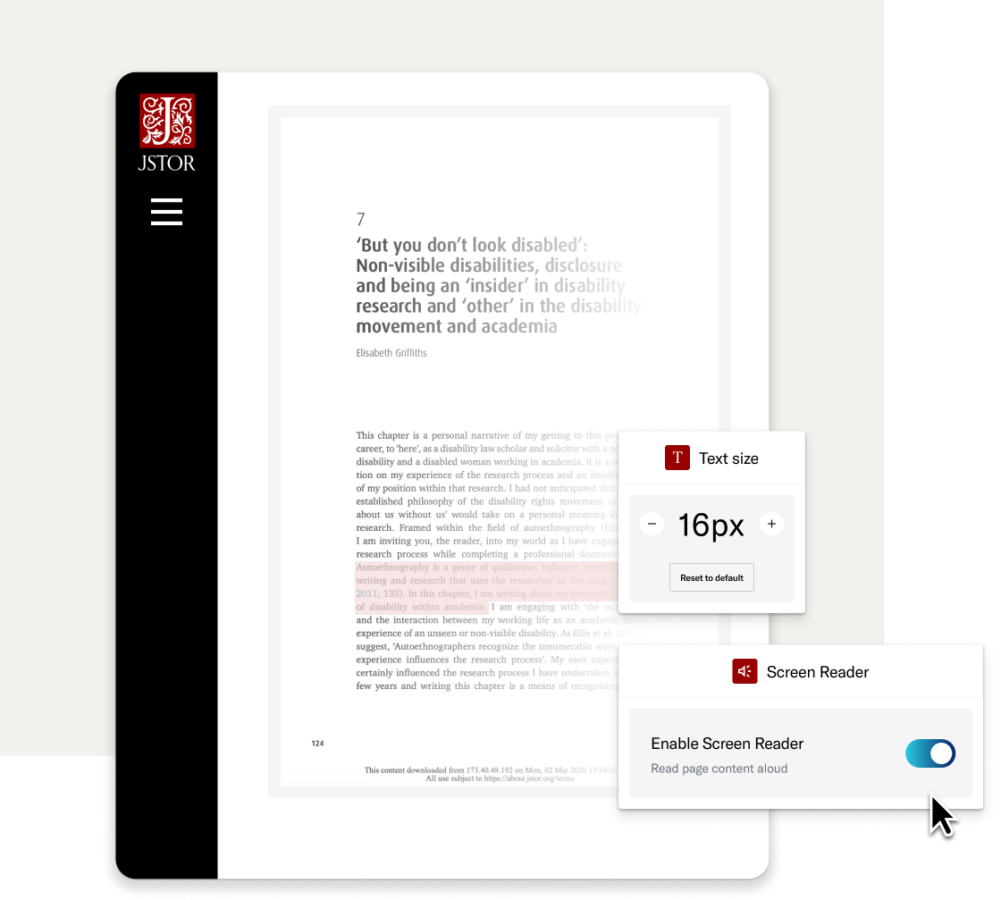
Tools like JSTOR Seeklight, which includes transcript generation for text-based materials, and will evolve to support additional accessibility measures like the creation of alt text, give institutions scalable, AI-assisted capabilities to support their own accessibility efforts while keeping human expertise at the center.
Together, these efforts reflect a shared direction: building accessibility into systems and workflows, not layering it on after the fact.
Accessibility is not a one-time project or a single deadline. It is becoming part of how trust is assessed across the scholarly ecosystem, among institutions, publishers, content contributors, and the platforms that connect them. At its core, that trust is about ensuring people can access the materials they need, when they need them.
As accessibility expectations evolve, so do institutional strategies. The leaders we spoke with are thinking long term about sustainability, scalability, and user impact. At JSTOR, we are doing the same, and will continue grounding our work in the perspectives of the institutions and users we serve.