This article is a part of the Inside & Connected series, which shares ideas, interviews, and projects that affect prison-based education, students, and educators.
When we talk about education in prison, the conversation often focuses on getting something, anything, in the door. Any material, any worksheet, any booklet will “do.” Tennessee Higher Education Initiative (THEI) refuses that premise.
We recently had a conversation with Kristen Payne and Tasha Reagan of THEI to learn more about their reentry work. It was immediately clear that they do not believe students inside should be grateful for whatever they receive. They believe students deserve the best. Kristen declared, “Students on the inside deserve excellence, and we aren’t going to stop short of that.”
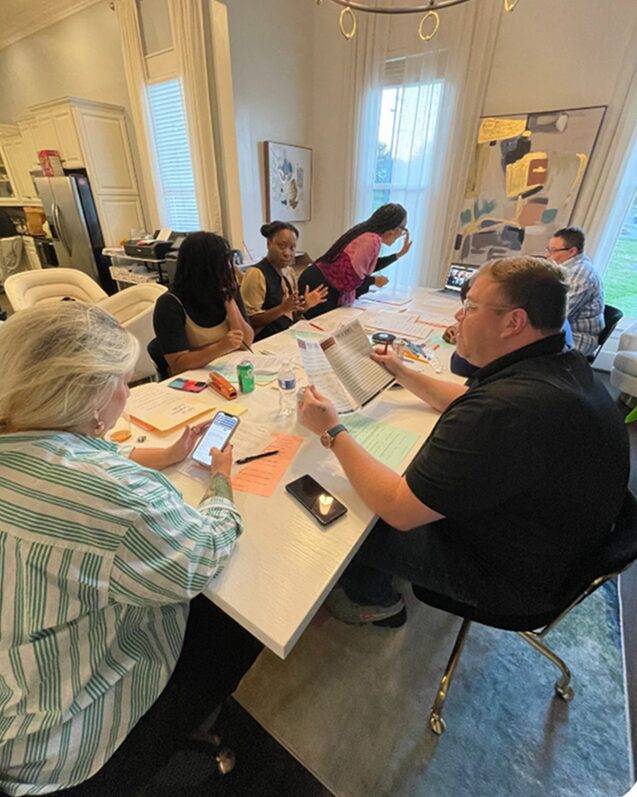
Both Kristen and Tasha lead THEI’s Navigating Forward project, a full suite of college-navigation resources designed specifically for learners who are incarcerated. The project was intentionally staffed and funded so that the team could spend their days listening to students, visiting facilities, mapping barriers, and designing solutions.
Rather than producing generic guides, THEI designed materials that are clear, visually beautiful, and above all, functional inside constrained environments.
Designing for dignity
Tasha described the heart of their design philosophy: when someone is inside, they’re already navigating scarcity of time, access, and autonomy. The default in prison education is to provide bare-minimum solutions. THEI challenges that. “We really gravitated toward the idea of creating something…not only approachable and useful, but beautiful.”Tasha’s philosophy is that beauty is a form of respect to signal that the student is worth investing in.
Empowerment, not dependency
What makes these resources different is not just what they teach, but how they are envisioned, crafted, and produced.
Before writing a single page, the team created mind maps. They imagined the barriers a student who is incarcerated could encounter such as internet restrictions, transcript confusion, Pell paperwork, and credit transfer. The team then designed “if this, then next” paths. “If they try this and it doesn’t work, what should they do next?” The goal was to equip students to advocate for themselves.
Kristen pushed back against the common assumption in prison education that students “don’t have agency” and therefore don’t need access to information. “Even if students don’t have agency, they need to understand what decisions are being made on their behalf.”
Agency is not a switch that flips after release. It is something practiced, built, and strengthened. While in prison, education is the training ground.
Invisible work, visible impact
One of the recurring themes in the conversation was credit transfer, a long-standing pain point across prison education programs nationwide. Students who earn credits inside often face roadblocks when they continue college on the outside.
Tasha and Kristen designed resources that give students the language and confidence to ask the right questions, such as:
- Do these credits transfer?
- If not, why not?
- What pathway exists to finish what I started?
The materials include space to take notes, build questions, reflect, and plan. They are intentionally student-centered. “There was space to take notes, journal, develop their own voice… their questions, their dreams.”
Students as architects of change
The deepest part of the conversation surfaced when we asked: why do you do this work?
Kristen spoke about the possibility that through education, students evolve into advocates, organizers, and leaders. “If we’re serious about reform…how do we create advocates right now?” One student once told her that incarceration felt like someone pressing pause on a record player. Education, he said, was the moment someone pressed play again.
That line stayed with her.
What others don’t see
THEI closed with a challenge to higher education:
“Go inside. Watch a class. You will not see an academic experience more powerful than that.”
Because once someone witnesses the intensity of learning inside it becomes impossible to treat incarcerated students as charity cases. They are not recipients of generosity. They are scholars, innovators, and architects of their own futures.
THEI’s approach aligns deeply with how we see the world at JSTOR Access in Prison:
- Access matters.
- Design matters.
- Dignity matters.
It is a fair opportunity to press play.