
With growing participation, titles, and usage, the program shows early evidence that collaborative OA monograph publishing can work at scale
JSTOR announced that Path to Open, a community-supported open access monograph program, will continue as an ongoing program following its three-year pilot phase. Launched in October 2023 to test whether a collaborative model could sustainably scale open access for humanities and social sciences monographs, Path to Open includes nearly 300 participating libraries, over 50 university presses and scholarly publishers, and a corpus of titles that will reach 1,000 works by the end of 2026.
“Path to Open was designed in partnership with the American Council of Learned Societies (ACLS) and university presses to test whether a collaborative model could align the interests of libraries, publishers, and authors to expand access to scholarly work,” said Kevin Guthrie, President of ITHAKA and Managing Director of JSTOR. “We are now seeing compelling evidence that this approach can do what it set out to do. Moving from pilot to program reflects growing confidence in the model, and our commitment to continue learning and iterating upon its core design.”
The core design of Path to Open includes: 300 new titles selected for inclusion in the program each year; library support through annual licensing payments to access titles for up to three years before they become openly available; and per-title payments to presses to help sustain monograph publishing without requiring authors or institutions to pay processing charges.
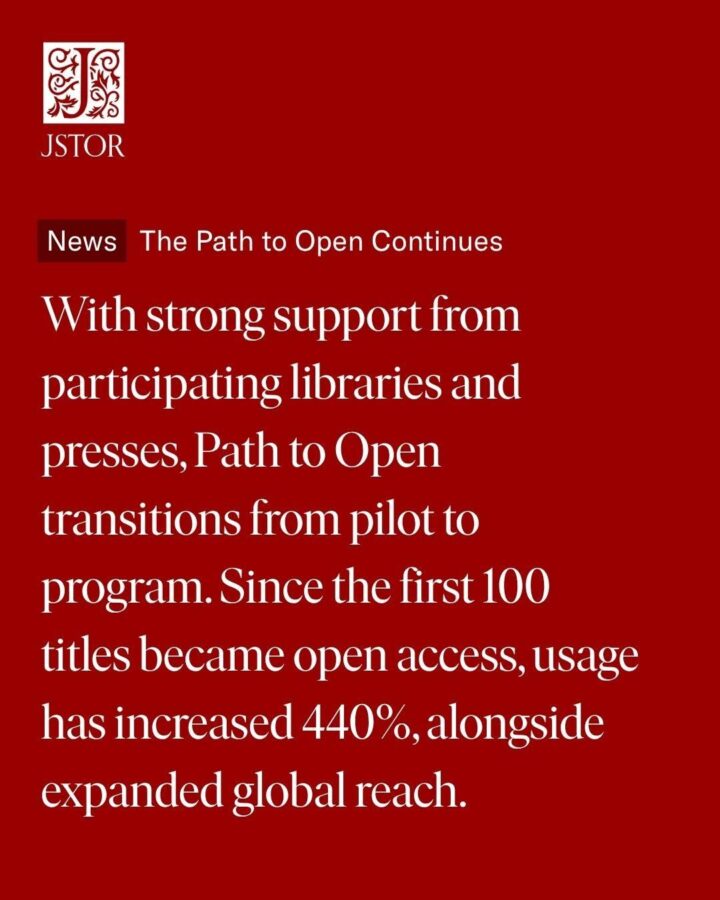
Early results from the first 100 Path to Open titles, published in 2023 and openly available since January 2026, illustrate what this model can enable. Usage among participating libraries was strong during the licensed period and grew significantly once titles became openly available. In the first three months after opening, item requests increased by more than 440% compared to the full year of 2025, when the titles were available only through participating libraries. Over the same period, access expanded from 228 to over 2,000 institutions and from 12 to nearly 160 countries—highlighting the global demand for high-quality, peer-reviewed titles.
“BLC has seen firsthand how Path to Open delivers real impact for libraries, authors, publishers, and, most importantly, the communities we serve,” said Charlie Barlow, Executive Director of the Boston Library Consortium. “We’ve seen steady growth in participation across BLC member institutions alongside strong usage of newly published titles, demonstrating the value of this shared investment model. The significant increase in usage globally once titles transition to open access underscores the long-term impact of this approach. We’re delighted to see JSTOR continue the program beyond its pilot phase, signaling a durable, collaborative model for expanding access to scholarly content.”
From the outset, Path to Open was built on a premise: no single stakeholder can solve the sustainability challenge of open access monograph publishing alone, but a coordinated, community-supported approach might. Pilot period feedback provides early market validation of that premise. Participating libraries broadly indicate that the program delivers meaningful value relative to investment and supports their open access priorities. Publishers report that the model aligns with their strategies and provides a viable framework for their continued participation. While directional, these findings suggest that the model is beginning to achieve the balance required to sustainably publish open access monographs.
One area of continued attention is the timing of when titles become openly available. The program initially described a three-year delay to open, but the actual time to open is often shorter—in some cases closer to 2 years, depending on publication timing. Feedback from libraries reflects a range of perspectives: some view the licensed access period as an important mechanism for sustaining publisher participation and enabling library investment—particularly for institutions unable to allocate funds to fully open resources—while others would prefer shorter embargoes or immediate open access. At the same time, this limited access period remains an important component of the model’s financial sustainability for participating presses and authors. JSTOR will continue to monitor this aspect of the model closely, working with libraries and publishers to ensure it remains effective and sustainable over time.
Another core priority of Path to Open is maintaining bibliodiversity—ensuring that open access supports a wide range of publishers, disciplines, and author perspectives, rather than consolidating scholarly publishing among a narrower set of participants. Titles in the program span more than 60 disciplines. The program has also expanded open access publishing among participating presses: 42 of 49 presses (86%) increased the number of OA books they published as a result of Path to Open, including 8 publishing OA for the first time. These outcomes reflect the role of community funding in enabling broader participation in open access and supporting a more diverse scholarly publishing ecosystem.
For authors working within that diverse ecosystem, the implications of open access extend beyond reach to the nature of scholarship itself. Philip P. Arnold, Professor of Religion and faculty member of Native American and Indigenous Studies at Syracuse University, whose title The Urgency of Indigenous Values recently became openly available through Path to Open, has described scholarship in his field as “inherently collaborative,” noting that open access makes it possible for “Indigenous peoples, lawyers, environmentalists, activists, [and] scholars everywhere around the world” to engage with the work.
Since becoming openly available in early 2026, the book has already reached readers in 48 countries—up from 6 countries during its initial licensed period—illustrating how open access can extend the global reach of specialized scholarship. “The accessibility of published works is really what we should be celebrating here,” he said.
As Path to Open enters its next phase, JSTOR will continue to expand participation and grow the pipeline of titles, while evolving the model as needed in collaboration with libraries and publishers to support a sustainable and inclusive future for open access monograph publishing.
Learn how to participate in Path to Open or register to join an upcoming webinar to hear from participating libraries and publishers.
About JSTOR
JSTOR is a mission-driven nonprofit dedicated to increasing access to knowledge. We work with libraries, museums, and publishers to preserve and bring to life scholarly materials, helping more people discover these collections and improve their lives through learning. Our research and teaching platform combined with our innovative collections stewardship tools, make information more affordable and accessible to current and future scholars everywhere. JSTOR is a part of ITHAKA.