
JSTOR Blog
-
“It’s in the reach of my arms, / The span of my hips, / The stride of my step, / The curl of my lips. / I’m a woman/ Phenomenally. / Phenomenal woman, / That’s me.” – Maya Angelou Women have long been used as inspiration for art. They have served as muses to both…
-
This post was edited to reflect the change from Shared Shelf to JSTOR Forum. We invited Lee T. Pearcy of Bryn Mawr College’s Department of Greek, Latin, and Classical Studies, to discuss the Classicizing Philadelphia project. One way to think about America’s relationship with ancient Greece and Rome is to imagine a dialogue. Listen carefully as you wander around Philadelphia.…
-
July 1, 2014 will mark ten years since the Artstor Digital Library became available for educational use. Today, nearly half a million registered users at more than 1,500 educational institutions around the world use the Library for their research and teaching. We are always fascinated by the work being done using Artstor – from Lois…
-
This post has been updated to include new information about Artstor’s public collections, formerly made available on Shared Shelf Commons. At the beginning of the nineteenth century the prevailing medical belief that “the more dangerous the disease, the more painful the remedy” meant that bloodletting, purging, and blistering were often prescribed. Not surprisingly, this led…
-
As we get close to Easter, you’re sure to run into at least a few mentions of the renowned Fabergé eggs. And rightly so, as these decorative objects are ingenious and rich with history. But did you know there is much more to Fabergé than just eggs?
-
Since its opening in 2011 at the Montreal Museum of Fine Arts, the haute couture and prêt-à-porter designs in “The Fashion World of Jean Paul Gaultier: from the Sidewalk to the Catwalk” have been electrifying audiences in Montreal, Stockholm, Brooklyn, and Dallas—and now, London. I had the opportunity to see the exhibit at the Brooklyn…
-
Saint George’s Day is celebrated on April 23. I know this because as a child I was obsessed with the world of make-believe. While my sister was collecting books on the natural sciences, I had a whole shelf devoted to children’s versions of Greek mythology, fairy tales, and folklore. The stories I loved best involved…
-
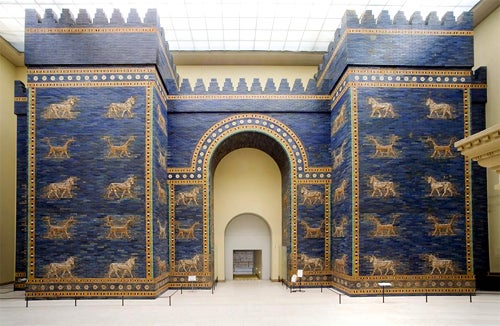
Travelers to ancient Babylon were met with an astonishing sight: a gate nearly 50 feet high and 100 feet wide made of jewel-like blue glazed bricks and adorned with bas-relief dragons and young bulls. Dedicated to Ishtar, goddess of fertility, love, and war, the main entrance to the city was constructed for King Nebuchadnezzar II…
-
One hundred years ago today, suffragist Mary Richardson walked into the National Gallery, London and attacked Diego Velázquez’s The Toilet of Venus (AKA The Rokeby Venus) with a meat cleaver. Richardson was protesting the arrest of fellow suffragist Emmeline Pankhurst the previous day. You can see the impressive results of the National Gallery‘s restoration by searching…
-
Albrecht Dürer created his famous woodcut of a rhinoceros in 1515 based on a written description and an anonymous sketch of an Indian rhino that had arrived in Lisbon earlier that year. The animal was intended as a gift for Pope Leo X from the king of Portugal, but it never reached its destination, perishing…
-
We are delighted to announce that Artstor is collaborating with the Franklin Furnace Archive to introduce videos in the Digital Library in the coming months. Franklin Furnace has been championing performance and other ephemeral arts for more than three decades. Martha Wilson, Franklin Furnace’s founding director, elaborates on the significance of this collaboration: While there…
-
The mission of Aalto University is to create a new science and arts community. In this video, chief information specialist Eila Rämö explains how Aalto uses Artstor.
-
In an unusual event, temperatures dropped below freezing in all 50 states Tuesday after a polar vortex swept southwards. As NBC New York explains, “The polar vortex forms every year to the north, but large blocks of high pressure over Greenland and the Southwest weakened the jet stream in recent days, allowing part of the polar vortex to break off…
-
By Ayesha Akhtar, User Services Assistant What winter in the Northeast means for most is being able to get away with wearing black and gray, staying home in lieu of going out for fear of catching a cold, and wearing a troublesome amount of layers. But for me, grey winter skies provide the perfect backdrop…
-
Wishing you could access the Artstor Digital Library at home over the winter break? You can! One of the many benefits of registering for an Artstor account is the ability to access the Digital Library away from campus.
-
This post has been updated to include new information about Artstor’s public collections, formerly made available in Shared Shelf Commons. Maine is famous for its winters, and understandably so – snow accumulation can reach up to 10 feet in parts of the state. This offers an irresistible opportunity for play, as you can see in…
-
It’s snowing today in New York City and crowds are lining up to skate at the legendary ice rink at Rockefeller Center, with its sparkling light displays and famous holiday tree. If I visit this year, it’ll be as a spectator only, since I’ve never ice skated in my life. Sad, I know, but I…
-
By Mark Branner, University of Hawaii, Manoa I have the great privilege of teaching an introductory college-level course on puppetry. Even though it is an introductory course, it is actually classified as an upper division course, which means that I generally have juniors and seniors straggling in, looking for an easy “basket-weaving” escape. There are…
-
Rob Stevenson’s Electronic Field Guide Project’s image collection is composed of more than 200 images of turtles, many of them photographed by Susan Speak. Stevenson is an Associate Professor in the Biology Department at UMass Boston, where he works on problems related to conservation physiology, environmental informatics, and science education.
-
by Laura Schroffel, Library Assistant in Special Collections Cataloging at the Getty Research Institute Co-published with The Iris, the online magazine of the Getty. The Getty Research Institute recently collaborated with the Artstor Digital Library to digitize and share approximately 6,500 images from the Julius Shulman photography archive, series II and III. The work of…
-
Some of the more controversial nudity in Michelangelo’s Last Judgment was painted over the year after the artist’s death. Those additions were left intact when the Last Judgment was restored in the 1990s, but thanks to a farsighted cardinal we can see what the fresco looked like before it was censored. The Last Judgment was commissioned for the…
-
by Emmabeth Nanol, library assistant in Special Collections Cataloging at the Getty Research Institute Co-published with The Iris, the online magazine of the Getty. The Getty Research Institute recently partnered with the Artstor Digital Library to digitize and make available approximately 1,500 selections from the Alexander Liberman photography archive, from the series “Artists and Personalities.”…
-
We are thrilled to have been named as one of the two “best overall” databases of 2013 along with JSTOR by Library Journal. Lura Sanborn, reference librarian at St. Paul’s School in Concord, NH is quoted as saying that “Both databases are ‘classics worth owning,’” and adding “My library simply could not get by without JSTOR…
-
Daylight Saving Time ended last night, which gives you an extra hour today to enjoy our slideshow of beautiful clocks and watches.
-
In the Journal of American Folklore, Lucile Hoerr Charles asks a question that doubles as a survey of clowns throughout the world: “What has the stage buffoon of the Chinese in common with the court fool of the Middle Ages in Europe; and with the stage fool in Elizabethan England, magnificently represented in Falstaff; and…
-
Tsukioka Yoshitoshi is widely recognized as the last great master of Ukiyo-e, or “pictures of the floating world,” the main genre of Japanese woodblock printing (and a major source of inspiration for many modernist artists from Europe). In his last series, New Forms of Thirty-six Ghosts, the artist depicts a variety of spirits and magic animals…
-
Georgetown University’s James J. O’Donnell is contributing images of Deir Mar Musa, a monastic compound north of Damascus, to the Artstor Digital Library. Here, O’Donnell gives us a short history of the site and shares his experience of visiting. Deir Mar Musa began life as a Byzantine watchtower, served as a medieval hermitage and modern…
-
Artstor’s AP® Art History Teaching Resources support the revised Curriculum Framework for the Advanced Placement® Art History course. The image groups and accompanying essays will eventually cover all 250 key works of art and architecture required for AP® Art History courses. Along with the Digital Library’s 1.8 million images, the project enhances classroom teaching in preparation…
-
October 4 is generally recognized as the feast day of St. Francis of Assisi, patron of the animals, steward of nature, and author of the Canticle of the Creatures. In a divinely ordained cosmos, Francis considered all elements – sun, moon, and stars, water and fire, and the animals – our sisters and brothers, and…
-
Rubén Durán, Senior Web & Video Developer at Houston Community College Central’s Curriculum Innovation Center, was kind enough to give us a little background on his collection of photographs of carnaval, which were recently released in the Artstor Digital Library. The riotous, rebellious world of carnaval came to life for me when I traveled to my…

Sign up for updates
Never miss a thing. Get updates from JSTOR delivered straight to your inbox.
By signing up you agree to our Privacy Policy. You may unsubscribe at any time by clicking on the provided link on any marketing message.
"*" indicates required fields